


Wanted: A Few More Like Irenaeus
by Timothy Teuscher
Pastoral and diaconal candidates at our two seminaries were recently placed in their first field of service and vicars assigned to congregations as part of their pastoral formation. While we thank God for raising up these individuals in our midst, the fact remains that our church is experiencing a shortage of church workers. This is why one of our synod’s Strategic Initiatives is to “recruit, educate, and support ecclesiastical, diaconal, and lay leaders for the church.”
To assist in this matter, I would point out that, this year, three of the minor festivals which happen to fall on a Sunday—St. Peter and St. Paul on June 29, St. Bartholomew on August 24, and St. Matthew on September 21—focus on those who were called by our Lord to be His apostles. What an opportune time for pastors to address this initiative in our congregations!
In addition to these minor festivals, there is also a calendar of commemorations of men and women from the Scriptures and from the subsequent centuries of the Church’s life who are recognized for their defense of the fundamental beliefs of the Christian faith and their examples of godly living. One such individuals is Irenaeus, who is commemorated on June 28 and whose influence continues down to our own time.
Irenaeus was born into a Christian family around the year 130 A.D. in Smyrna or modern-day Izmir, Turkey. In his early youth he was instructed by Polycarp who himself was a pupil of the apostle St. John. He then went to Rome to study under the tutelage of Justin Martyr and was subsequently ordained as a presbyter to serve the church in the city of Lyons in Gaul or modern-day France.
May the story of the early church father Irenaeus inspire us all to devote ourselves ever more faithfully to the hearing, reading, and studying of the Word of God—especially those young men and women in our midst who follow in his footsteps and devote themselves to fulltime work in Christ’s Church.
In 177 A.D. Irenaeus was sent to Rome to deal with the Montanist heresy that was causing problems in churches throughout the Roman Empire. ‘Montanism’ was named after a self-appointed teacher by the name of Montanus, and Montanists were somewhat similar to the Pentecostals or Charismatics of today who claim that the Holy Spirit speaks to them directly, apart from the prophetic and apostolic Scriptures. Irenaeus wrote this about Montanus and others like him: “God shall also judge false prophets, who, without having received the gift of prophecy from God, and not possessed of the fear of God, but either for the sake of vainglory, or with a view to some personal advantage, or acting in some other way under the influence of a wicked spirit, pretend to utter prophecies, while all the time they lie against God.”
It was during his absence from Lyons that persecution of the church in Gaul arose under orders from the Roman emperor, Marcus Aurelius, resulting in the death of their bishop. Upon his return, Irenaeus was appointed as his successor. Little is known of his later years, including how he died around the turn of the third century.
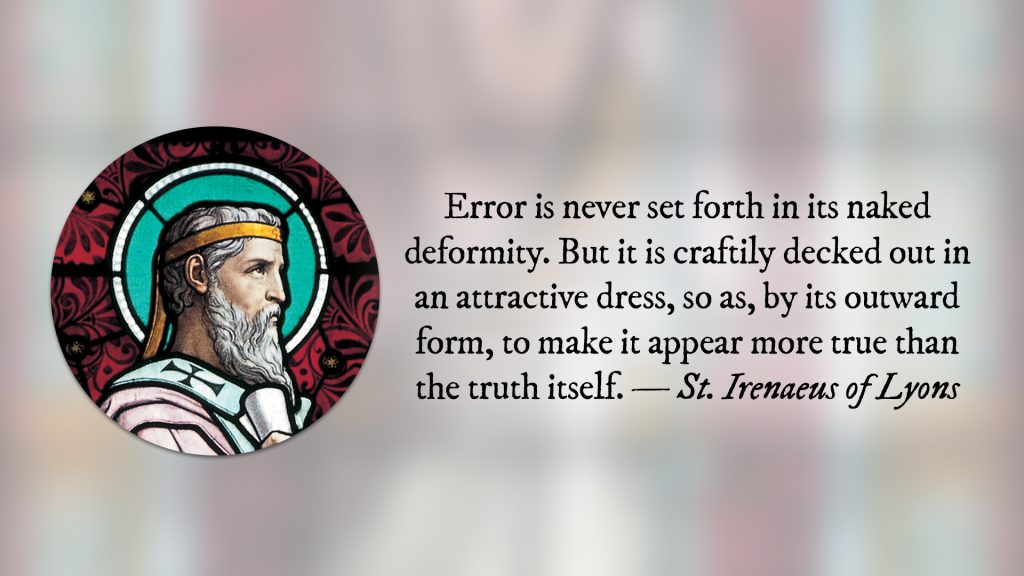
What we do have, however, is Irenaeus’ most important writing entitled Against Heresies, which begins with these words: “Error is never set forth in its naked deformity. But it is craftily decked out in an attractive dress, so as, by its outward form, to make it appear more true than the truth itself.” And, yes, we, too, are living at a time when there is quite a fashion show of error and false teachings.
Irenaeus then proceeds to expose and undress a number of these errors and false teachings; especially what is called ‘Gnosticism’ which, in brief, was an intrusion into the Christian church of elements of Greek philosophy, Persian dualism, and pagan mystery cults. At its heart was the conviction that matter is evil or indifferent, that redemption is freedom of the soul or human spirit from the body which comes about through secret knowledge, and that it doesn’t really matter what is done to or with the body.
In a sense, Gnosticism is still around today. In fact, it has become the prominent religion, so to speak, in our society today, infiltrating not only many a church but our entire society. Same-sex marriage… gender identity… abortion… ordination of women into the office of the holy ministry… medical assistance in dying (MAID)… calling God ‘our Mother’ rather than ‘Father’ as we do in the Creed and in the Lord’s Prayer… all of these are modern-day fruits, as it were, of Gnosticism.
Irenaeus saw all this for what it really is—not only a denial of God as the Creator and Preserver of all that exists, and a rejection of His commandments dealing with life in the body, but even worse. For it is contrary to the very heart of Christian faith—a denial of the incarnation of our Lord Jesus Christ, of His death on a cross as the atoning sacrifice for the sins of the world, of His rising from the dead with a glorified body, of His giving us His very body and blood to eat and drink in and with the bread and the wine of Holy Communion, and of our own bodily resurrection to eternal life.
Where did Irenaeus get these ideas? Simple: from the New Testament, the only norm and basis and authority for what the church—whether it be in Irenaeus’ day or ours—believes, teaches, and confesses. So he says: “The ground and pillar of our faith is the Scriptures handed down to us by the will of God.”
May the story of the early church father Irenaeus inspire us all to devote ourselves ever more faithfully to the hearing, reading, and studying of the Word of God—especially those young men and women in our midst who follow in his footsteps and devote themselves to fulltime work in Christ’s Church.
—————
Rev. Dr. Timothy Teuscher is President of Lutheran Church–Canada (LCC).
 LCC Facebook
 LCC Instagram