




Christ Incarnate: Love Revealed and Given
by M.L. Smith
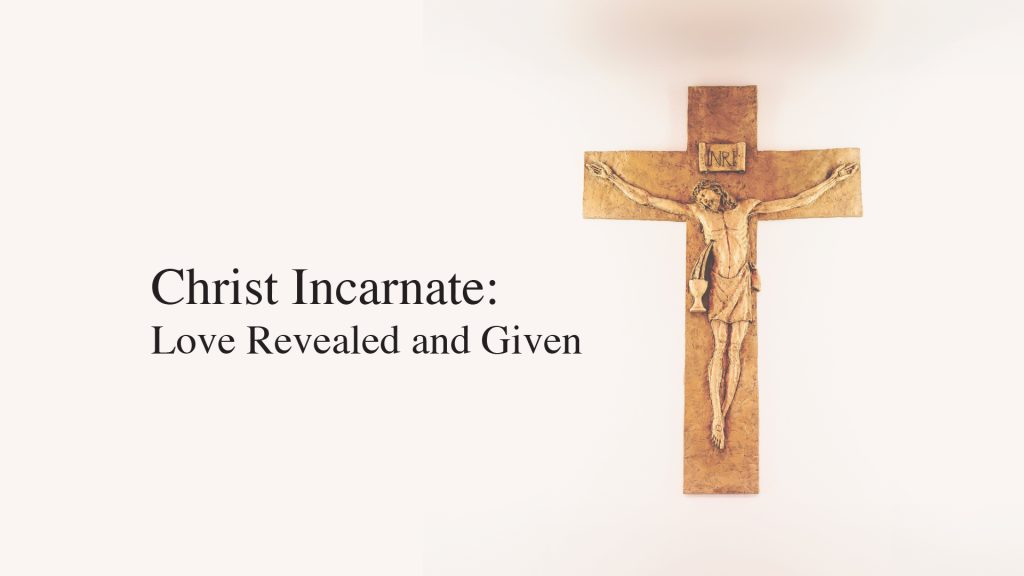
“God is love” (1 John 4:8). These three words contain a universe of meaning. But in the Christian confession, they are not an abstraction or a sentiment. They are flesh and blood. They are Christ crucified and risen. They are a pierced side, a chalice of forgiveness, a body given for the life of the world. In Jesus Christ, the incarnate Son, we see not only the love of God revealed, but the love of God bestowed—real, sacrificial, and present.
The Fulfillment of the Scriptures
The unity of the Scriptures lies not in moral instruction but in the One who fulfills them. The Old Testament proclaims God’s steadfast love through promises, covenants, and saving acts. The New Testament unveils the fullness of that love in Jesus of Nazareth—God in the flesh—who is not merely a teacher of divine truths but the divine truth in person. Not a messenger, but the message itself. Not only does He proclaim the Kingdom of God—He embodies it.
Love has a name. Love has a face. Love has wounds. Jesus Christ is the incarnate love of God.
Jesus’ parables are not clever illustrations—they are autobiographical revelations. The Shepherd who seeks the lost, the Father who runs to embrace the prodigal, the Bridegroom who comes at midnight—all point to the One who came “to seek and to save the lost” (Luke 19:10). On the cross, Christ does not merely speak of love—He becomes it. Love suffers. Love dies. Love rises.
Love in Flesh and Blood
 The clearest expression of divine love is not only in Christ’s suffering but also in His giving. The night before He died, Jesus gave His body and blood to His disciples, instituting the Holy Supper as the perpetual feast of His self-giving. In the Sacrament of the Altar, love becomes tangible: not a memory or symbol, but Christ Himself—given and received.
This is no mystical ascent on our part, no reaching up to God through human striving. It is God stooping down to us. It is love descending. The eternal Logos, through whom all things were made, now nourishes us not with ideas, but with Himself. The true Bread from heaven feeds His people with the fruits of His cross—His body, His blood, His forgiveness, His life.
As Martin Luther confesses in the Large Catechism, “This treasure is conveyed and communicated to us in no other way than through the words ‘Given and shed for you’” (LC V, 29). Here, “for you” is the Gospel in its purest form—love delivered.
A Body United in Love
But the Sacrament does not only unite the believer to Christ; it unites the whole body of believers to one another. As Paul writes, “Because there is one bread, we who are many are one body” (1 Corinthians 10:17). The love of God poured out in Christ creates community—a Body. The Church is not a voluntary society but instead a communion born of divine love, sustained by divine gifts, and shaped by divine calling.
We, in turn, do not love merely because it is commanded. Instead, “we love because He first loved us” (1 John 4:19). This love, received in Word and Sacrament, overflows into daily life. It is not generic. It is concrete. It looks like compassion for the weak, mercy for the fallen, hospitality for the stranger, and help for the poor.
Christ does not divide love of God and love of neighbour. In Him, they are one. As He says, “As you did it to one of the least of these My brothers, you did it to Me” (Matthew 25:40). To ignore our neighbour is to ignore Christ. To serve our neighbour is to love and serve Christ.
Faith Active in Love
The Christian life is not built upon moralism or abstract charity. It is rooted in Christ, who gives Himself to us through His Word and Sacraments, creating saving faith through His Spirit. Faith justifies, but faith is never alone. It is living and active. It bears fruit. Faith, therefore, is a divine work in us which transforms us, making us a new creation in Christ.
This new life takes shape in concrete vocations, in service, in prayer, and in witness, as we breathe in the love of Christ through His Means of Grace and breathe out His love in service to our neighbour. The Church’s mission then is not merely to inspire admiration but to bestow Christ. And the life of her members is not self-fulfillment, but self-giving—because Christ has given all.
Love Has a Name
Love has a name. Love has a face. Love has wounds. Jesus Christ is the incarnate love of God. He is the Shepherd who seeks the lost, the Lamb who bears their sin, and the Host who feeds them with Himself. In Him, God has turned toward us, embraced us, forgiven us, and drawn us into His own life.
Let us then love—not in our strength, but in His. Not as mere obligation, but as gift. Not as abstraction, but in truth and deed. And let us behold in Christ crucified not only the image of love, but its enduring source.
“Behold what manner of love the Father has given unto us, that we should be called the children of God—and so we are.” – 1 John 3:1
—————
Rev. M.L. Smith is Director of International Missions of Lutheran Church–Canada (LCC).
 LCC Facebook
 LCC Instagram