

Living as One Body
by Marvin Bublitz
Times are changing in the life of many congregations. It seems like only yesterday that our pews were full and we had more than enough people to serve in offices. A vacancy was only for a short time, as the number of pastors available was plenty. Not only did our pews have an abundance but our chequing accounts had surplus.
Yes, times were good back then. But now… now we struggle. Church buildings that can seat hundreds barely fill a few pews. Council positions sit vacant. Volunteers are in short supply. And pastors are in even shorter supply. It is difficult to get pulpit supply. Congregations may sit vacant for two to three years or more.
Yet, it is not the same everywhere. Some congregations seem to be doing well even in these difficult days. So, with some congregations doing well and others struggling, what is a people to do?
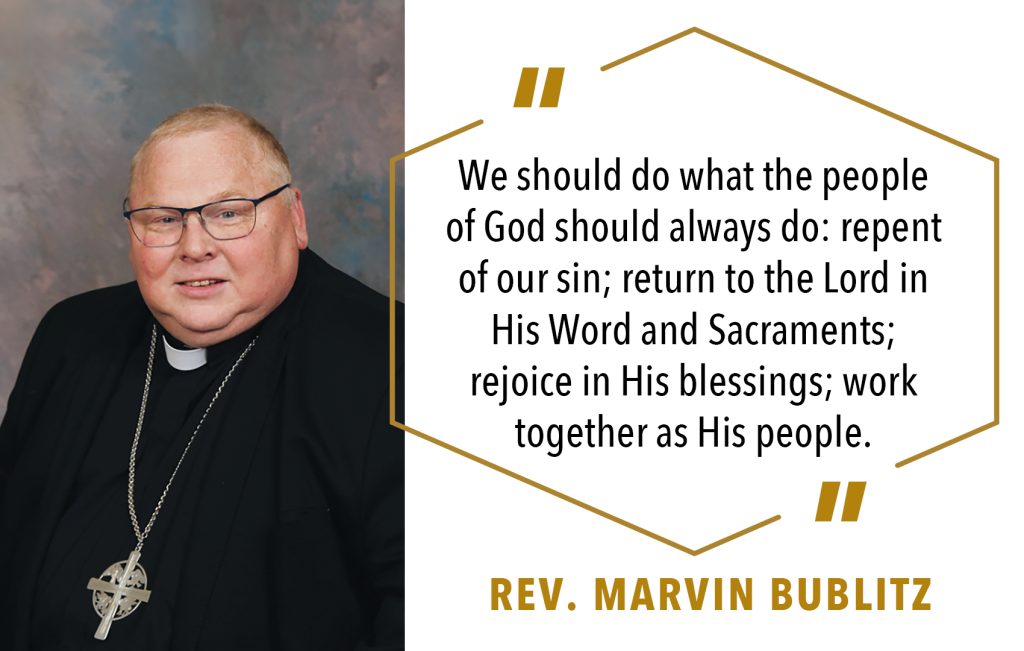
We should do what the people of God should always do: repent of our sin; return to the Lord in His Word and Sacraments; rejoice in His blessings; work together as His people.
For the body does not consist of one member but of many. If the foot should say, “Because I am not a hand, I do not belong to the body,” that would not make it any less a part of the body. And if the ear should say, “Because I am not an eye, I do not belong to the body,” that would not make it any less a part of the body. If the whole body were an eye, where would be the sense of hearing? If the whole body were an ear, where would be the sense of smell? But as it is, God arranged the members in the body, each one of them, as He chose. If all were a single member, where would the body be? As it is, there are many parts, yet one body.
The eye cannot say to the hand, “I have no need of you,” nor again the head to the feet, “I have no need of you.” On the contrary, the parts of the body that seem to be weaker are indispensable, and on those parts of the body that we think less honourable we bestow the greater honour, and our unpresentable parts are treated with greater modesty, which our more presentable parts do not require. But God has so composed the body, giving greater honor to the part that lacked it, that there may be no division in the body, but that the members may have the same care for one another. If one member suffers, all suffer together; if one member is honored, all rejoice together.
Now you are the body of Christ and individually members of it.
– 1 Corinthians 12:14-27
As the body of Christ, we work together, and those with plenty share with those in need. That can sound all nice and fine in a sermon, a Bible study, or an article. What about where the rubber meets the road? What about in day-to-day practice in His Church? How does the Body of Christ operate in these days? Well, people can either operate with the Old Adam in the driver’s seat or the with the heart of the New Man in Christ.
If the Old Adam is in control, people do what is best for themselves, and congregations do what is best for themselves. Thoughts like “be warm and well fed” (James 2:6) are spoken, but nothing is done to help. Each congregation strives to be autonomous. They do what is best for themselves and ignore the others. The thought of working together, joining together, or sharing a pastor is foreign. Rather, in the spirit of the pharisee, they say, “I thank God we are not like those other congregations.” Such thoughts, talk, and actions are not befitting the people of God for whom Christ shed His holy blood.
The New Man in Christ recognizes it is the Lord’s Church. It is Jesus who died for her. He is in control. So, the New Man in Christ, washed in His Baptism, forgiven in His blood, and fed at His table, strives to care for the whole body in their need.
“So then, as we have opportunity, let us do good to everyone, and especially to those who are of the household of faith” (Galatians 6:10). When the rubber meets the road, we work together. In practice, it means every congregation needs to ask how we can work with the other parts of the Body of Christ in this area and across Synod. It means each congregation being willing to sacrifice for the good of the whole.
I implore each of you to honestly consider how working together in ministry might benefit the area in which the Lord has placed you in His Church. The parts of the Body of Christ are not autonomous from each other. Rather, “God arranged the members in the body, each one of them, as He chose… God has so composed the body, giving greater honour to the part that lacked it, that there may be no division in the body, but that the members may have the same care for one another. If one member suffers, all suffer together; if one member is honored, all rejoice together” (1 Corinthians 12:18, 24b-26).
Almighty God grant that we live and work together as the Body of Christ, especially in these times of need. Amen.
—————
Rev. Marvin Bublitz is Lutheran Church–Canada’s East Regional Pastor.
 LCC Facebook
 LCC Instagram