


Christmastide Reformation
by David Haberstock
In Luther’s day, the Western Church conducted the liturgy in Latin, even though few in Europe had spoken Latin for almost 900 years (the Roman Empire had fallen 1,100 years earlier, and Latin morphed into the Romance languages). As a result, the Word of God was not being read in the language of the people, and the people’s faith had slowly departed from God’s Word.
During that time, the Church itself had looked to sources of authority other than the Bible, such as tradition, philosophy, reason, superstition, and mystical experiences. But then along came Martin Luther (and others), and the Lord used them to spark a renaissance of reading the Scriptures in their original languages (Hebrew for the Old Testament and Greek for the New) and translating the Word into the languages people now spoke. This resulted in a re-examination of what the Church was teaching and doing in the light of what the Bible actually taught.
Since 2017 and the 500th anniversary of Luther’s nailing of the 95 theses on the doors of the Castle Church in Wittenberg, we have been in a series of 500th anniversaries. Last year marked the 500th anniversary of the first Lutheran hymnal, and a proliferation of hymn writing by Luther and his circle. This year marks the 500th anniversary of the Deutsche Messe—the German Mass, or as we call it now, the Divine Service.
That makes sense. Worship is, after all, a logical place to begin reforming and correcting errors in teaching and practice. We all know that “actions speak louder than words,” and that means what we do and say in worship is going to have an impact on what we believe. And what we believe ought to match our actions. The two must be consistent with each other, or people will know we are hypocrites and just playacting.
So, eight years in, as Luther’s teaching of Scripture and the need for reform in the Church took hold, his hearers were asking for a unified reform of their worship. Luther did not wish to become a new pope or authority; he desired Scripture to be the ultimate authority. But God gives us pastors and doctors of the Church to be our teachers—to be His living voice in our midst, to bring alive His Word and proclaim and apply it to our lives. So someone needed to conduct a reform of the liturgy. The Deutsche Messe was that reform.
Luther had already laid out basic principles for liturgical reform in his 1523 tract “Concerning the Order of Public Worship.” And in December of 1523, Luther had published a Latin “Order for Mass and Communion for the Church at Wittenberg.” The only German portions were the sermon and a few hymns. A Latin service was good for the scholars in Wittenberg, but not useful to the regular folk in town or village. Luther called for more hymns by German poets. He himself worked on this task throughout 1524, publishing the first Lutheran hymnal (the Eight Song Book) as well as multiple other hymns. Many of the hymns were chorale settings of parts of the liturgy.
1525 was a turbulent year for Luther. In January, he published Against the Heavenly Prophets to deal with some false prophets who were stirring up crowds to destroy art in churches. In May, his prince, Fredrick the Wise, died. And Luther married in June. But by the end of 1525, he had begun working on the “German Mass,” which was first used on December 25, 1525.
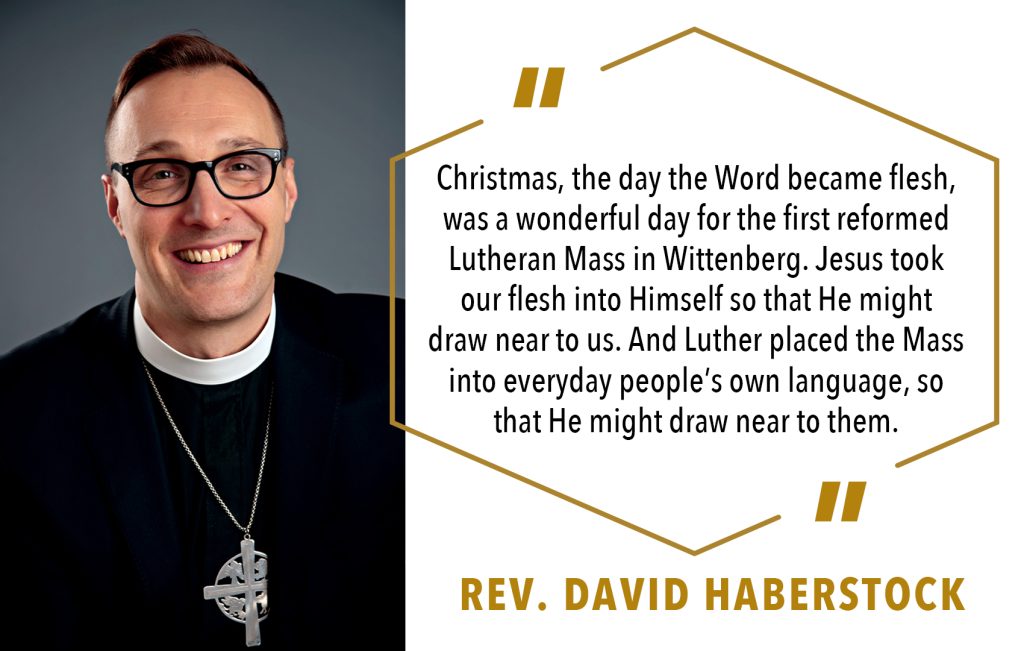
Christmas, the day the Word became flesh, was a wonderful day for the first reformed Lutheran Mass in Wittenberg. Jesus took our flesh into Himself so that He might draw near to us. And Luther placed the Mass into everyday people’s own language, so that He might draw near to them. Since faith comes by hearing (Romans 10:17), the Divine Service needed to be in a language people could hear and understand.
But Luther also wanted the people to be taught what the parts of the service do so that they could fully participate with heart and voice. Thus, the songs (or canticles) of the liturgy were not only translated but also paraphrased and explained in hymn form. Divine Service Setting Five in the Lutheran Service Book lists the liturgical songs that Luther wrote, if you want to know what that first Lutheran Christmas service sounded like and what those songs said.
Jesus is the great gift our Heavenly Father gives to this world. To receive and hear of Jesus in your own language, so that you might believe and be granted life and salvation—what a Christmas that must have been!
—————
Rev. David Haberstock is Lutheran Church–Canada’s Central Regional Pastor.
 LCC Facebook
 LCC Instagram