




Do We Need Epiphany?
by Timothy Teuscher
What if Epiphany never happened? No star, no magi from the east, no gold or frankincense or myrrh, no questioning from King Herod, no flight by the holy family into Egypt, no twelve days of Christmas. Would it really matter all that much, except to reduce a few pieces from our nativity scenes, along with a few Christmas carols that refer to the wise men?
In fact, maybe it would have been better if it never happened. No baby boys in Bethlehem put to death by Herod. No “Rachel weeping for her children… because they are no more” (Matthew 2:18). No holy family fleeing to a foreign country, with all the hardships that must have entailed. What’s so important about Epiphany, then, that some congregations still gather on January 6 to celebrate the event?
St. Paul answers for us in the epistle reading for the day: “This mystery is that the Gentiles are fellow heirs, members of the same body, and partakers of the promise in Christ Jesus through the Gospel” (Ephesians 3:6). In other words, the account of the wise men shows us that Jesus is born for all people: for Jews and non-Jews, for rich and poor alike—be they wise men from the East or factory workers from the West.
Perhaps this seems obvious since we have heard it so often. And yet, St. Paul calls this a “mystery”— something that we would not know had it not been revealed to us from above. That’s what the word “epiphany” means: “to reveal, to make known.” It is in the visit of the wise men to the Christ Child that God makes this mystery known. This newborn Child is born for all. Christmas is for all. His love and forgiveness is for all.
Apart from God making this known to us, we could never be sure that this newborn King is our King.
Apart from God making this known to us, we could never be sure that this newborn King is our King. After all, Jesus is born “King of the Jews” (Matthew 2:2). That’s what the wise men call Him. But so what? Kings are born every day, and most don’t matter much to us. Why should we care that the King of the Jews has been born?
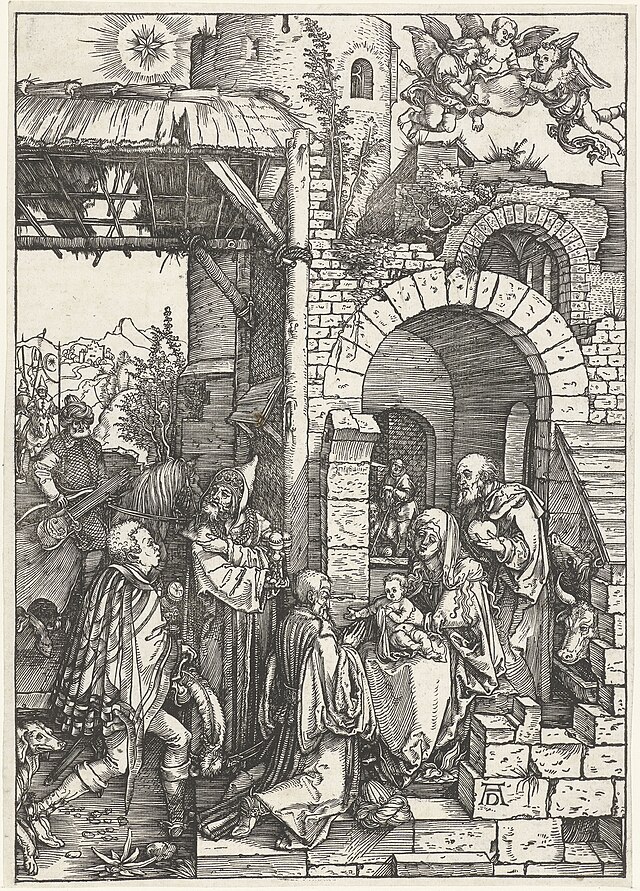
Albrecht Dürer, The Adoration of the Magi, woodcut ca. 1501–1503.
Simply, because He is no ordinary, earthly king. An earthly king rules over a particular territory or nation—but not this King. His kingdom is not of this world; He rules over the entire universe. An earthly king demands to be served—but not this King. He comes to serve us. And not just 2,000 years ago, but still today in the Divine Service. An earthly king has the best of the best—but not this King. He is poor and humble and lowly. An earthly king has others fight and die in order to save him—but not this King. He dies in order to save us.
No, Jesus is no ordinary, earthly king. Not much of a king at all, some would say—wearing a crown of thorns and nailed to His own throne. But maybe this means that He is more than an ordinary king. King of the Jews? Yes, but more than that. King of the universe. King of creation. Our King. Living not in one place or one time, but in all places and times. Ruling not just one people, but all peoples.
This is what God has revealed to us, what He wants us to know and believe: that this baby—lying in a manger, visited by Jewish shepherds, and worshipped by Gentile wise men—is your King. No matter where you live. No matter when you live. No matter who you are. That is why the Gospels record the variety of the people who come to Jesus: Jewish shepherds and Gentile wise men, lepers and tax collectors, Pharisees and Roman centurions. And today we see the same variety of people. People no longer separated by culture, race, or language, but united by faith in Him. People born anew as children of God by water and the Spirit in Holy Baptism. People who partake of the same heavenly food. People who are fellow citizens of the kingdom of heaven itself.
The magi may have been wise in the eyes of others and rich in the things of this world, but one thing they did not have—at least, not until they heard the Word of God that the King of the Jews was to be born in Bethlehem, followed the star there, saw the Child with His mother Mary, and worshiped Him with their earthly treasures of gold, frankincense, and myrrh. For then they were given what all the riches and wisdom of this world could never buy or attain: eternal life.
 The same is true for us today. Your King has come to serve you; to save you; to forgive you; to die for you; to feed you with heavenly food; to wash you clean from sin; to speak His Word of grace and mercy to you; to rule in your heart and your life. If God had not revealed this in His Word, we would never know it. The mystery would have remained a mystery. But on this Twelfth Night (sometimes called the “Gentile Christmas”) to us, as to the wise men of old, has also been given an epiphany, a revelation—namely, as St. Paul writes in the Epistle for this holy day: “This mystery is that the Gentiles [that would be you and me!] are partakers of the promise in Christ Jesus through the Gospel” (Ephesians 3:6). And that is worth celebrating!
—————
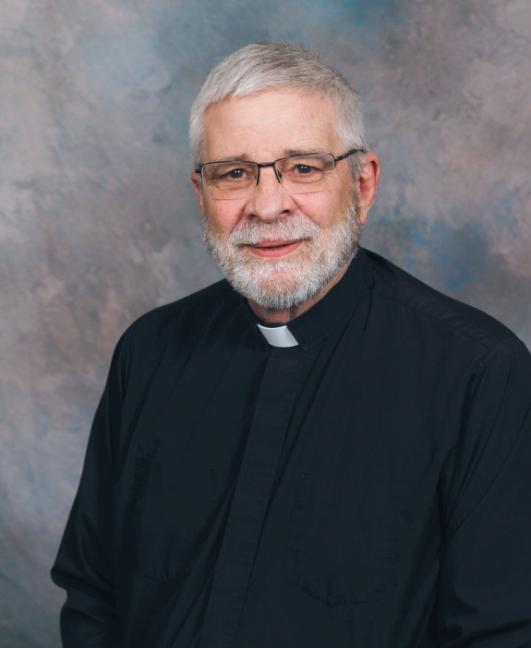
Rev. Dr. Timothy Teuscher is President of Lutheran Church–Canada.
 LCC Facebook
 LCC Instagram