


Words from the Cross
by Daryl Solie
“For the word of the cross is folly to those who are perishing, but to us who are being saved it is the power of God.”
1 Corinthians 1:18
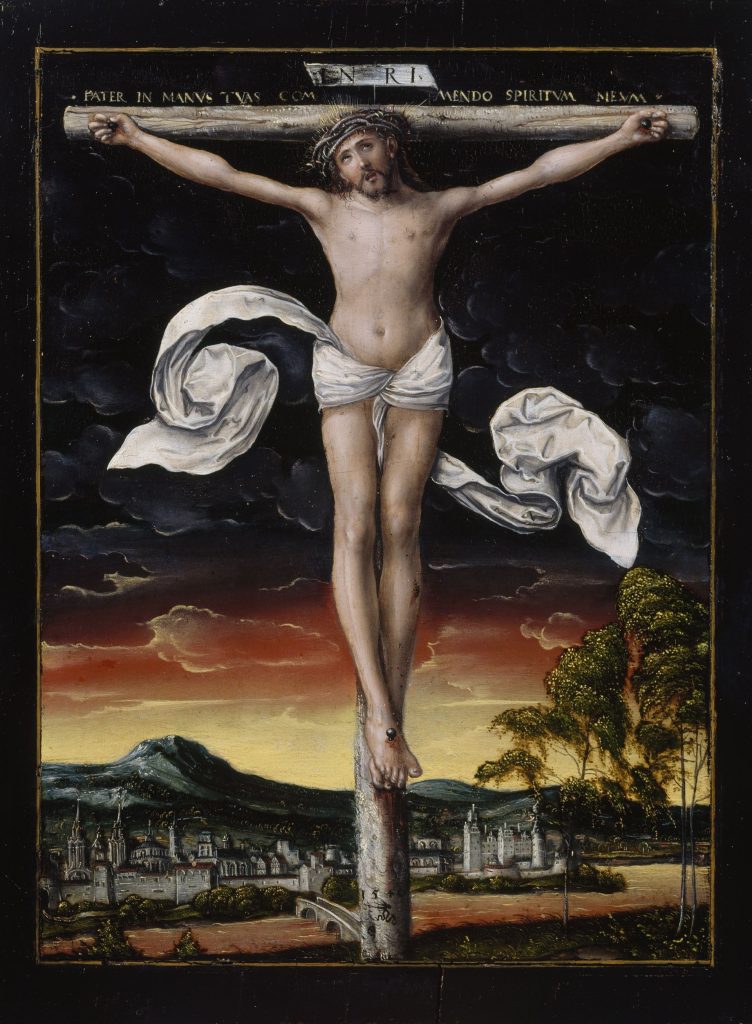
Christ on the Cross: Lucas Cranach the Elder, 1540. The Latin text above Christ reads: “Father, into your hands I commend my spirit.”
On Good Friday our Lord spoke seven brief statements—words we often call the “Seven Words from the Cross.” Drawn from the four Gospels, these Words aren’t simply the final words of a dying man but are words from the voice of the Saviour Himself, revealing the meaning of His suffering and death, and pointing us toward the central truth of the Christian faith: Jesus Christ died in the place of sinners to win forgiveness and eternal life.
The First Word:
“Father, forgive them, for they know not what they do” (Luke 23:34).
The soldiers gambled for His clothes. Religious leaders mocked Him. Nails pierced His hands and feet. Yet instead of speaking in anger or revenge, what does Jesus do? As our Great High Priest, even on the cross (Hebrews 4), He prays for the forgiveness of the ones calling for His death. And Jesus isn’t just setting an example of forgiveness; He is actually accomplishing it, taking humanity’s place under God’s judgement for sin—suffering and dying as our substitute (substitutionary atonement). He bears the punishment we deserved so that we might be forgiven and reconciled to God. Paul writes: “God shows His love for us in that while we were still sinners, Christ died for us” (Romans 5:8). Through the Church, the forgiveness Jesus won on the cross continues to be delivered to us through the means He has established in the preaching of the Gospel, Holy Baptism, Holy Absolution, and the Lord’s Supper.
Our ascended Lord also continues to intercede for us. John writes that “we have an advocate with the Father, Jesus Christ the righteous” (1 John 2:10). As our Advocate and Great High Priest, He represents us before the Father, bringing our prayers, praises, and sacrifices of thanksgiving to the Father and making us acceptable and pleasing in the sight of God for His sake (1 Timothy 2:5).
The Second Word:
“Truly, I say to you, today you will be with Me in paradise” (Luke 23:43).
Two criminals were crucified beside Jesus. One mocks Him, demanding that Jesus prove Himself by escaping the cross and saving him too. The other repents and confesses his guilt. The penitent thief knows he has nothing to offer—no works, no reform, no future obedience. He simply clings to Jesus and begs: “Remember me when You come into Your kingdom.”
Jesus answers with a promise: “Truly, I say to you, today you will be with Me in paradise.” Salvation is based on Jesus’ Word and promise, not our worthiness. Our Lord’s use of the word “today” teaches us that, at death, the soul of the believer is immediately in Christ’s presence. The word “paradise” expresses the blessed condition of believers between death and the resurrection. For the believer, at death, the soul is with Christ until the final resurrection when body and soul are reunited at Christ’s return.
The thief’s body would be buried. But that very day, his soul would be in the joyful presence of Christ, until the Last Day when his body would be raised imperishable (see John 5:28-29, Philippians 3:21, 1 Corinthians 15:42-43, and Philippians 3:21).
In this Word we see clearly the biblical teaching of justification by grace through faith (see Ephesians 2:8-9; Romans 3:28; and Galatians 2:16). The thief is saved not by his works but by trusting in Christ’s mercy. His story is our story—empty hands, full promise.
The Third Word:
“Woman, behold your son… Behold your mother” (John 19:26–27).
Even in agony, Jesus shows compassion, caring for His mother. Entrusting her to John’s care, He ensures that she would be provided for (it is believed that Joseph had died by this point). But in His Third Word, we not only witness our Lord’s deep compassion toward His mother but also His perfect obedience.
To be the acceptable sacrifice for the sins of the world Jesus had to accomplish what we could not do: keep God’s Law perfectly. As one who “in every respect has been tempted as we are, yet without sin” (Hebrews 4:15), He perfectly keeps the Fourth Commandment to “Honour your father and your mother.” He saves us not only by dying in our place (passive obedience) but by fulfilling the Law (active obedience). And His obedience is credited to us.
At the foot of the cross, we also see the beginnings of a new family—the family of believers, as well as the sanctifying (“making holy”) of ordinary vocations, demonstrating that the Christian life is lived out in service to others.
The Fourth Word:
“My God, My God, why have You forsaken Me?” (Matthew 27:46; Mark 15:34).
Tradition has it that Martin Luther, reflecting on this Word from the Cross, said: “God forsaken by God—who can understand it?” Indeed, apart from faith it is hard to understand, for here we see the depth of our Lord’s suffering for sin. Fulfilling the messianic prophecy of Psalm 22:1, He experiences the full weight of God’s judgment against human sin, suffering in our place with our sin placed on Him and His righteousness given to us. This is the Great Exchange. The Father turns His face away—not in hatred of the Son but in judgment against sin. The Son is forsaken so that we never will be. As Paul writes: “For our sake He made Him to be sin who knew no sin, so that in Him we might become the righteousness of God (2 Corinthians 5:21).
The Fifth Word:
“I thirst” (John 19:28).
The statement “I thirst” demonstrates our Lord’s real human suffering as true man as well as true God. He experiences physical pain, exhaustion, and thirst. The eternal Son of God took on real human flesh and endured the full weight of human suffering (Hebrews 4:15).
John notes that this statement also fulfilled Scripture, as the suffering described in Psalm 69—including the offering of sour wine—is fulfilled, reminding us that our Saviour is not distant from human suffering. He knows our weakness and pain because He entered fully into our human condition.
The One who cried, “If anyone thirsts, let him come to Me and drink,” now thirsts Himself that He may later give the Water of Life freely in Holy Baptism, quenching thirst eternally for all who believe.
The Sixth Word:
“It is finished” (John 19:30).
The exclamation “It is finished” doesn’t simply express that our Lord’s life has ended, but that His work of salvation has been fully accomplished. The Greek word here—tetelestai—means “paid in full” or “accomplished.” Nothing remains for us to add; Jesus’ sacrifice is sufficient. The demands of the Law and the penalty of sin have been paid in full by His death on the cross—not by force but willingly out of love for us. John writes that Jesus is the “propitiation for our sins, and not for ours only but also for the sins of the whole world” (1 John 2:2; see also 1 John 4:10 and Romans 3:23-25).
For believers, these words bring certainty and comfort. Nothing more is needed for our forgiveness. We receive it freely through faith, resting in the finished work of Christ, who has conquered sin, death, and the devil. God’s plan is completed and our eternal life is assured.
The Seventh Word:
“Into Your Hands I Commit My Spirit” (Luke 23:46).
In His final Word, fulfilling Psalm 31:5, Jesus entrusts Himself completely to the Father, resting in the Father’s care, even in death. His life was lived in perfect obedience, and His death is the final act of that obedience.
In the face of death, these last words of our Lord also become a prayer of faith for believers. Christ rose again from the dead. Because Christ has conquered sin and death, Christians can die in hope. Death, painful as it is, becomes an act of trust; we commend ourselves into the hands of the same faithful Father until the resurrection.
For centuries, reflection on the Seven Last Words has been a treasured Good Friday and Lenten tradition. But they are more than mere tradition. They proclaim essential truths of the faith like accomplished atonement, justification by grace alone, the true humanity and true divinity of Christ, fulfillment of Scripture, the completion of redemption, and the certainty of eternal life.
Above all, they direct faith away from the self and toward Christ alone who gave His life for us that we might live forever with Him. “In Him we have redemption through His blood, the forgiveness of our trespasses, according to the riches of His grace” (Ephesians 1:7).
Rev. Daryl Solie is pastor emeritus of Prince of Peace Lutheran Church in Regina.
 LCC Facebook
 LCC Instagram