



Koinonia: Not Just Fellowship
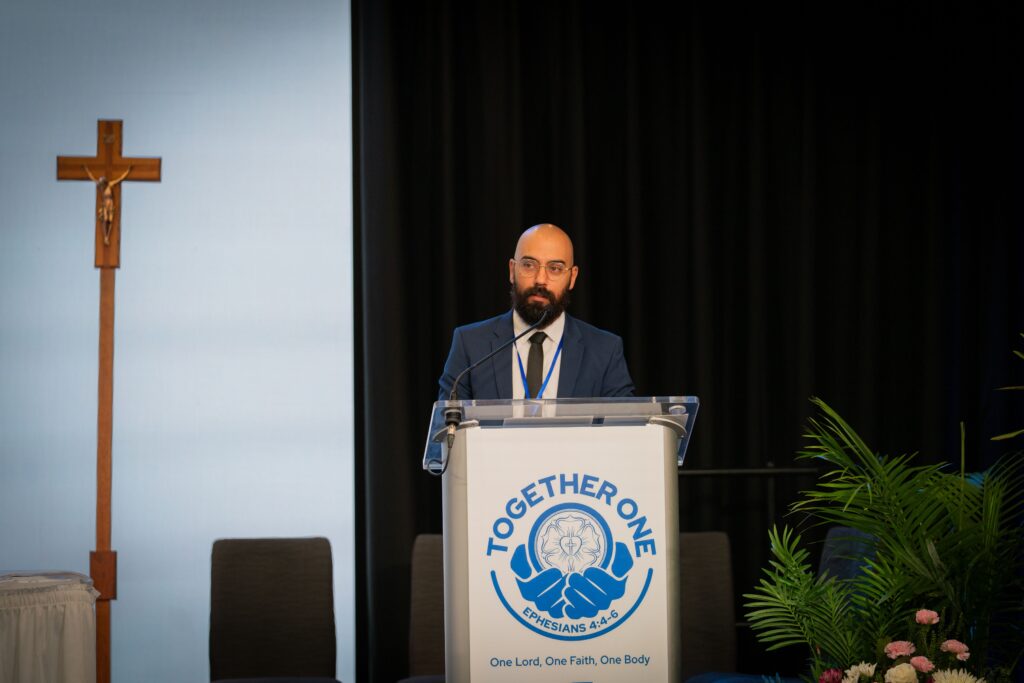
Photographed by Sura Tulu
On Saturday morning, Rev. Dr. Alex Vieira presented his keynote essay: “Koinonia in the New Testament”. Dr. Vieira is Associate Professor of Exegetical Theology at Concordia Lutheran Seminary in Edmonton, Alberta.
“Koinonia seems like a word we already know,” said Dr. Vieira. “Most of us would say it means fellowship and leave it at that… but I want to show that it is not enough, and that the distance between the meaning we assume and the meaning the New Testament shows is important to us.”
Dr. Vieira began by describing uses of the word koinonia outside the New Testament, describing the act of being shared participants in something, such as a business deal or marriage. From here, he turned to the New Testament, going through the instances where koinonia is used in Acts and the Epistles of Paul and John to describe our fellowship in Christ.
First, he examined koinonia in the context of God, Gospel, and faith. Koinonia, Dr. Vieira observed, is not something that we simply participate in with one another; rather, it is the shared reality we experience as believers. “The Son Himself is the shared reality,” he asserted. “Believers are linked together because they all participate in the reality of Jesus’ benefits and life.”
Dr. Vieira also discussed koinonia in the Lord’s Supper. “By participating together in the exact same body and blood, a tangible unity is forged among the believers,” he said. During communion, we do not just share in the visible reality of the bread and wine, but also the shared reality of the real and present body and blood of Christ.
He also covered koinonia in materially helping others. In these texts, the koinonia or “thing in common” is the whole event of giving, not just the shared offering. Together, these verses show that koinonia “is not just a warm sentiment or a vague spiritual association,” but a “tangible action of Christians actively participating in the physical needs of others.”
Dr. Vieira also covered the use of koinonia in 1 John, and its difference from the way it is used in Acts and Paul’s Epistles. Dr. Vieira pointed out that its purpose here is unique. It emphasizes the importance of connection to apostolic teaching and the church both because the disciples were witnesses of Christ and because the apostles and the church have fellowship with God. In other words, the church isn’t just a social group. The point of John’s usage of the word is to show the importance of the fellowship we have with each other through Christ: “There can be no authentic church community that is connected to God but isolated from one another, just as there can be no true church community that is intimately connected with one another but severed from the truth of the Father and the Son.”
Finally, koinonia was examined in how it affects how we relate to one another. It is not something we do ourselves; rather, “it requires a third thing at the centre of our shared life in Christ.” Here we see how important it is to have this shared centre in our lives relating to the church, both with LCC and partner churches and with other Christians. It also shows how we cannot have koinonia in the New Testament sense with the world at large, which does not share our faith in Christ. However, as Dr. Vieira points out, “the line drawn around koinonia is not a wall to keep the world out, but the reason we speak to the world at all.”
To close out the talk, those gathered together recited the Apostles Creed, emphasizing the “koinonia of saints”. The talk built on the convention’s theme of “together one”, but it also reminded us why we are here together–not just because of our connections to each other, but ultimately because of our shared reality and identity in Christ.
 LCC Facebook
 LCC Instagram