




The Church as a Hospital for Sinners
“Those who are well have no need of a physician, but those who are sick. I came not to call the righteous, but sinners.”
Mark 2:17
The Church is not an exclusive country club for saints, but a hospital for sinners. This truth is easy to confess and just as easy to forget.
We long for a Church without conflict, without scandal, without disappointment. We imagine a holy people unmarred by failure, untouched by hypocrisy, untroubled by weakness. And when sin appears within the Church we are tempted to despair. How can this be Christ’s Church? we ask. How can the Body of Christ be so wounded?
Yet Christ never promised a Church free from sinners. He promised a Church filled with them. He founded His Church precisely for sinners, establishing a place on earth where He Himself would come to heal them with the medicine of His grace.
The Pharisees expected holiness to keep its distance from corruption. They believed purity was preserved by separation, righteousness by avoidance. But God incarnate does not recoil from sinners. He draws near to them. He speaks the truth to them. He calls them to repentance and binds up their wounds.
Like the man lying half-dead along the road, sinners are not left to heal themselves or to prove their worthiness of rescue. Instead, Christ comes to them where they lie—broken, bleeding, and unable to save themselves. He stoops down, pours on them the oil and wine of His mercy, binds their wounds, and carries them to a place of care. The Church is that inn, where the wounded are received, nourished, and cared for at His expense (Luke 10:30-35).
This healing comes at great cost. The Church is a hospital because Christ Himself became the wounded One. He was pierced for our transgressions and crushed for our iniquities. Upon Him fell the chastisement that brought us peace, and by His wounds we are healed (Isaiah 53). The medicine He gives is nothing less than His own life—given into death on the cross to cleanse and heal sinners.
The Church’s holiness does not consist then in the moral purity of her members, but in the presence of Christ Himself—in His living Word and life-giving Sacraments. Where Christ is present, forgiveness is delivered. Where forgiveness is delivered, life begins anew.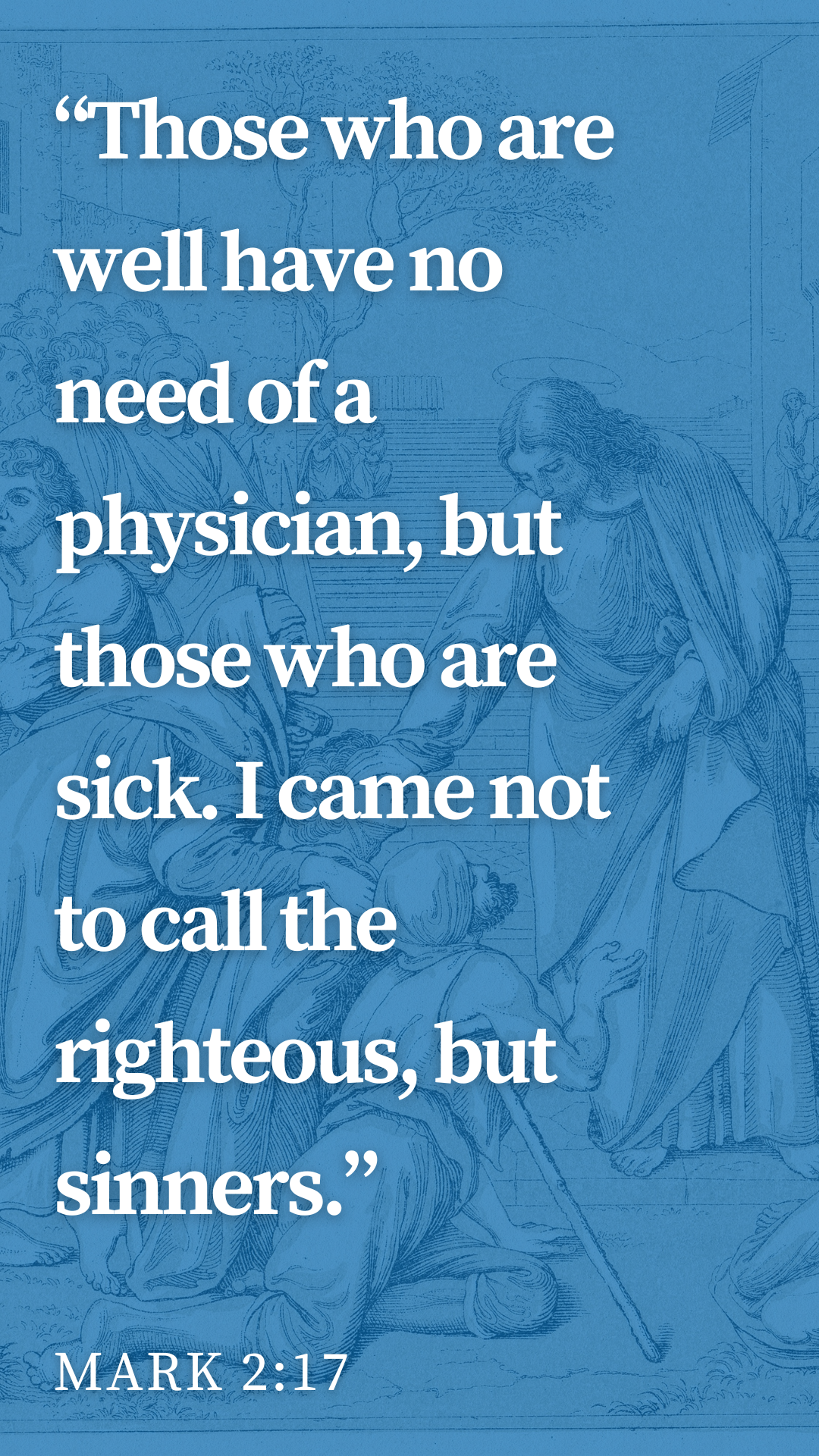
Jesus does not wait for healing before welcoming; He welcomes in order to heal. His Church, therefore, is not the place where the sick are turned away, but where the Great Physician gathers those broken by sin, burdened by guilt, entangled in addiction, crushed by shame, and exhausted by the long struggle against the flesh. Here, sinners are not defined by their chains, the wounded are not reduced to their failures, and the broken are not asked to pretend they are whole. Here, consciences terrified by the Law are met with the comfort and peace of the Gospel.
In Holy Baptism, the sick are admitted into this hospital and united to Christ’s death and resurrection. In Holy Absolution, the Great Physician applies the balm of forgiveness into wounded consciences. In the Holy Supper, His very body and blood—once given and shed on the cross—are placed into the mouths of sinners as medicine for immortality, bestowing His righteousness and strengthening faith. These are not symbols of healing. They are the very means by which Christ heals.
Still, the Church limps. She bears scars. Old wounds reopen. New ones appear. Her people stumble, grieve, repent, and return. Do not abandon the Church because her members are wounded. Those wounds are the very reason she exists.
You are not called to the Church because it is spotless. You are called to the Church because you are not. Hospitals are places where sickness is exposed, not hidden. The danger is not that sin is revealed, but that it is denied. Where sin is named, repentance can be spoken. Where repentance is spoken, forgiveness can be delivered. And where forgiveness is delivered, the healing power of the Gospel is at work. The miracle of the Church is not that Christians never fall. The miracle is that Christ never fails to raise them.
From this hospital, the healing Word is delivered—not from the perfect, but from the forgiven; not from the polished, but from the healed. Those who have been found learn to seek the lost. Those who have been carried learn to bear one another’s burdens. Those who have been healed return again and again to the place where healing is given.
The day is coming when the work of healing will be complete—when Christ will present His Church to Himself in splendor, without spot or wrinkle or any such thing (Ephesians 5:27). Until then, the Church remains the place where the Great Physician still comes—not to admire the healthy, but to raise the sick to life by His grace.
 LCC Facebook
 LCC Instagram