





Mission Begins in Love: Caring for the Flock of Christ
by M.L. Smith
“So then, as we have opportunity, let us do good to everyone, and especially to those who are of the household of faith.” —Galatians 6:10
The mission of Christ’s Church is a mission of love—love received, love shared, love sent. From the cross to the ends of the earth, the Gospel goes forth with power, calling all people into communion with their crucified and risen Saviour. Our Lord has commissioned His Church to go into all nations, baptizing and teaching with His own authority (Matthew 28:18–20). Yet before that Word reaches the far corners of the earth, it begins somewhere closer.
It begins in the sanctuary. In the pew. In the quiet corners of suffering and hope within our own congregations. It begins at home.
This is not a turning inward, but a faithful grounding of our outward call. Evangelism and pastoral care are not rivals—they are companions. The health and faithfulness of our congregations directly impact the strength and credibility of our evangelism. A congregation alive with Christ’s compassion is a captivating light that cannot be hidden.
A Faithful Ordering of Love
St. Paul’s words in Galatians give us a clear priority “especially to those who are of the household of faith.” This does not diminish our call to the world—it deepens it. Evangelism begins with the love we show one another. It begins with tending the wounded among us, rejoicing with the joyful, weeping with the grieving, and shepherding the wandering. When the Church lives in this way, it becomes not only a messenger of grace but a living embodiment of it.
This isn’t about abandoning outreach—it’s about anchoring it. When Christ’s love is alive and visible in our own midst, it naturally overflows into the world. Congregations that are strong in the Word, vibrant in worship, and compassionate in care become living signposts of God’s kingdom—visible testimonies of His grace, mercy, and presence in the world. When a congregation listens to the broken-hearted, prays with the suffering, rejoices in Christ’s gifts, and walks together in humility and hope, the world sees something different, something unique—something holy.
The Shepherd’s Call
Christ has given His Church shepherds—pastors called not only to preach and teach, but to know, visit, forgive, comfort, and guide the flock entrusted to their care. The Office of the Holy Ministry is deeply personal, because our Lord’s care is personal. He does not deal with His people in abstraction, but in the proclaimed Word, in the cleansing water of Baptism, in the bread and wine of the Supper—through tangible means, through human voices bearing His own, through real presence.
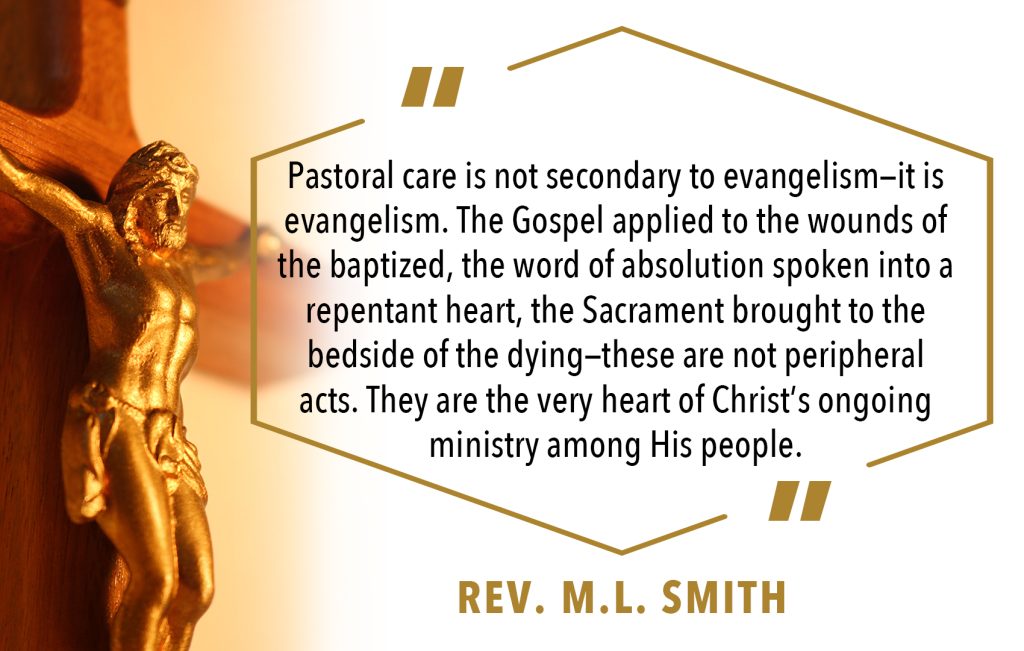
Pastoral care is not secondary to evangelism—it is evangelism. The Gospel applied to the wounds of the baptized, the word of absolution spoken into a repentant heart, the Sacrament brought to the bedside of the dying—these are not peripheral acts. They are the very heart of Christ’s ongoing ministry among His people.
To serve as Christ’s undershepherd is to participate in His mission: to seek the lost, strengthen the weak, and feed the flock He purchased with His own precious blood—fulfilling the call by doing the work of an evangelist (2 Timothy 4:5). This is not a burden, but a holy privilege.
When the shepherd knows his sheep, and the sheep hear the voice of Christ in his, the Church becomes a refuge of grace, a hospital for the hurting, and a beacon for the lost.
The Church That Loves Its Own
When the Church is healthy—when it embodies what it teaches—it becomes a light that the world notices. As the early believers devoted themselves to the apostles’ teaching, the fellowship, the breaking of bread, and prayer (Acts 2:42), their life together bore visible witness to the grace of Christ. The world saw their love and was drawn to it: “See how they love one another.”
The same Christ who calls us to love one another also gives us His Spirit to do so. He feeds, forgives, strengthens, and binds us together as His Body. He places each member in the Church not by accident but by design, that we might serve one another in love and bear witness together to His saving grace.
This remains true today. Our doctrine may be clear and our outreach strategic, but if love is not visible among us, our witness is dimmed. But when we notice the hurting, welcome the lonely, forgive the repentant, and walk patiently with the struggling, the Gospel becomes tangible. This is not innovation; it is faithfulness. This is not a new method; it is the ancient pattern of the Body of Christ.
Love Is the Mark of Discipleship
Jesus said, “By this all people will know that you are My disciples, if you have love for one another” (John 13:35). Love is the distinguishing mark of those who belong to Christ—not a human achievement, but the natural fruit of grace. “We love because He first loved us” (1 John 4:19). God’s love, poured into our hearts through the Holy Spirit (Romans 5:5), becomes visible in how we live as His Church.
Our Lutheran confession never separates doctrine from love; it unites them. A faithful church is one where both are present—truth and tenderness, Word and mercy, the cross and compassion.
The same Christ who calls us to love one another also gives us His Spirit to do so. He feeds, forgives, strengthens, and binds us together as His Body. He places each member in the Church not by accident but by design, that we might serve one another in love and bear witness together to His saving grace.
Let the Mission Begin Again
Let us not look past the gifts right in front of us. The members of our congregations—young and old, strong and weak, joyful and hurting—are Christ’s own precious possession. They are the flock He has called His Church to tend, feed, and care for. And as we care for them faithfully, the mission of Christ unfolds, one soul at a time.
Healthy churches are the best evangelists. Congregations filled with God’s love, grounded in the Word, nourished by the Sacraments, and alive with Christ’s mercy are the ones that shine brightest in a dark and weary world. And it is through these very congregations that the Holy Spirit draws others into the household of faith.
So let the mission begin again—right where you are. In your church. In your pew. In your sharing. In your prayers. In your love.
May the Lord of the harvest continue to gather, strengthen, and send His Church—in truth, in mercy, and always in love.
—————
Rev. M.L. Smith is Director of International Missions of Lutheran Church–Canada.
 LCC Facebook
 LCC Instagram