



Koinonia in Christ
by Alex Vieira
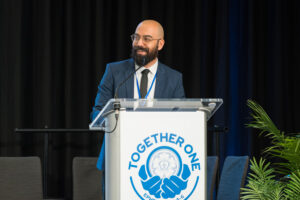
Photographed by Thomas M. Winger
Koinonia seems like a word we already know. Ask around, and most of us would say it means “fellowship” and leave it at that. That is not wrong. But I want to show that it is not quite enough, and that the distance between the meaning we assume and the meaning the New Testament shows is important for us….
Paul is the most frequent user of the word koinonia in the New Testament, and it is in his writings that the ordinary meaning (participation in something in which others also participate) shows most clearly. What is striking is that he places God Himself as the shared thing (person) in contexts where he uses the word koinonia. For instance, in 1 Corinthians 1:9, he writes: “God is faithful, by whom you were called into the koinonia of His Son, Jesus Christ our Lord.” Some translators obscure this by rendering it “fellowship with His Son,” implying mere association between the believer and the Lord Jesus. But when we take into consideration that koinonia ordinarily means participating in something in which others also participate… we realize that Paul is not picturing believers as enjoying Jesus’ company the way one enjoys a friend’s. The Son Himself is the shared reality. Believers are linked together because they all participate in the reality of Jesus’ benefits and life.
This is the language of our incorporation into Christ, where Christians (both the Corinthians and us) share in the same Lord. In this passage we see that our participation in Christ is initiated not by our own effort, but by God’s action of calling us. Since participating in something is a dynamic reality, it inherently implies action on the side of the participants. By using this language of active participation, Paul is highlighting what the Corinthians do, rather than just their static state of being the church. That dynamic action can be seen in the very next verse: “I appeal to you, brothers, by the name of our Lord Jesus Christ, that all of you agree, and that there be no divisions among you, but that you be united in the same mind and the same judgment” (1:10). Even here, the idea of participation in something along with others is at the forefront….
In 1 Corinthians 10:16, Paul writes: “The cup of blessing that we bless, is it not koinonia in the blood of Christ? The bread that we break, is it not koinonia in the body of Christ?” Here, Paul affirms the real presence of the Lord in the Supper. The shared reality is not just bread and wine, but the actual body and blood of Jesus. However, if we pay close attention to Paul’s language, his primary focus in this specific verse is not just highlighting our individual union with Christ. His focus by using the word koinonia is on the corporate nature: by participating together in the exact same body and blood, a tangible unity is forged among the believers.
This is where koinonia becomes visible among us. It is a corporate event that requires a gathered body…. The Lord’s Supper, therefore, bridges the vertical and the horizontal. It is the most tangible, physical expression of koinonia we have. Because we mutually participate in the divine reality at the altar, we are bound to one another in the pews.
John uses the word slightly differently from Paul…. Paul consistently uses koinonia to denote active participation in a shared reality (such as the Lord’s Supper or a financial contribution). However, John uses a unique construction, doing two things differently. John speaks of “having” koinonia…. In his use, the idea is that having koinonia with us is equivalent to ‘being one of us.’ Another difference in John is that…. he speaks of having koinonia with the apostles, with the Father and with the Son, and with one another….
The most striking part is not how John uses the term koinonia only, but why it shows up in his letter. After establishing that he and the apostles were eyewitnesses of the Word incarnate, he says that they proclaim those things so that the church may have koinonia with them…. John and the apostles proclaimed because they wanted the church to have fellowship with them. First, we need to be connected to the apostolic word, to their teaching, because they were witnesses of those things. There is a community created through their preaching. And second, he establishes right away that this community formed by their proclamation is not just a human partnership based on affinities. The whole point is that the apostles themselves have fellowship with God….
The church’s proclamation today as well should be so that people may have fellowship with us, because then they will also be in fellowship with God. A social gathering that is pleasant, and helpful, and close-knit, but that does not connect people to the Father and his Son, is fellowship, but it’s not the koinonia the apostle is talking about here. As John Stott put it: “We cannot be content with an evangelism which does not lead to the drawing of converts into the church, nor with a church life whose principle of cohesion is a superficial social camaraderie instead of a spiritual fellowship with the Father and with his Son Jesus Christ.”
In 1 John 1:6 we learn that we have koinonia with God if we do not walk in darkness. Drawing on John’s broader theology in this letter, we can say that koinonia with God is only possible for those who have received the light, the Word of truth, and have the Holy Spirit. Similarly, in 1 John 1:7, we learn that we have koinonia with one another as the blood of Jesus cleanses us from sin. Clearly, John’s description of the right kind of koinonia is a community in which all people have been saved through the apostolic proclamation and are therefore intimately connected to each other and to God. There can be no authentic church community that is connected to God but isolated from one another, just as there can be no true church community that is intimately connected to one another but severed from the truth of the Father and the Son.
What we see in 1 John 1, then, is a picture of koinonia that is simultaneously vertical and horizontal. John gives no margin for understanding community as a social bond disconnected from the apostolic witness, nor as a doctrinal proposition detached from lived relationships. The community formed through the proclamation of the incarnate Word is one in which people, by being joined to the Father and the Son through that proclamation, are thereby joined to the eyewitnesses. Strip out either the doctrinal content or the relational reality, and what remains is not koinonia in John’s sense….
Both [Paul and John] describe the same reality from different perspectives. Paul uses koinonia to show us what we share, and John uses the word to show us what it looks like when that sharing is genuine. Even where John says “koinonia with,” he presupposes participation in a shared centre: the apostles proclaim so that others may have koinonia with them precisely because the apostles’ own koinonia is “with the Father and with his Son” (1 John 1:3). The horizontal “with” rests on the vertical “with,” so the participatory structure is still there, only described from the side of the participants.
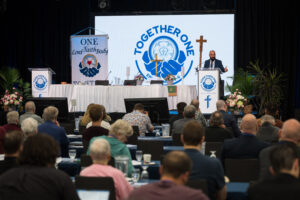
Photographed by Thomas M. Winger
Together, Paul and John give us a richer understanding of koinonia than the simple word “fellowship” can capture. Therefore, the New Testament’s complete picture of koinonia requires both dimensions to be held together. It is an active participation in God’s gifts, which at the same time constitutes and sustains an intimate, interdependent relation among all who participate….
From our exploration of koinonia in the New Testament above, we may say that a governing principle emerges for the life of the church. Koinonia is defined by the shared centre, not by the people who happen to gather around it. We are bound to one another only insofar as we are each bound to the same Christ, the same Spirit, the same Gospel, the same faith. This frames every practical question that follows. It means that no institution, roster, or shared circumstance can by itself produce koinonia, and that wherever the right centre is truly shared, koinonia is possible.
And the centre reaches far. The same Lord shared at the centre is large enough, and incarnational enough, to draw people to Himself from every nation, culture, and age, and to bind them to one another. The New Testament shows this happening among believers in places and times as different as Jerusalem and Corinth, Philippi and the congregations of John….
Within Lutheran Church–Canada and the church bodies with which we have pulpit and altar fellowship, koinonia finds its fullest expression. Because we hold the centre not merely in common but in common as we confess it, sharing the same understanding of God and salvation, Gospel and Sacraments, we are free to act that sharing out across the widest range of joint life: a common altar and pulpit, pooled resources, and partnership in mission. This is what I mean by the fullest expression of koinonia. It is not that we love these brothers and sisters more than those from other confessions of faith. It is just that the shared centre between us is confessed completely enough that almost nothing of our life together needs to be held back. We receive Christ’s body and blood side-by-side at the same altar. We recognize one another’s pastoral formation: I was trained at the seminary of another church body, and I was called to serve in LCC without having to begin my studies again. These are concrete and joint actions that express this deepest form of koinonia….
Koinonia is not a bond we generate between ourselves. It is about God holding us close to Him, and by extension to each other. This means that the main question for our life together is not “do we like one another enough to belong” or “are we similar enough to one another to belong,” but “are we connected to the same Lord by the means He uses to offer His gifts to us.”
And koinonia is something active. You cannot point to it on a membership roll, but you can catch it in the act the same way you would photograph any given action taking place…. Koinonia is not a word confined to a New Testament study, but it is lived out and even confessed together on Sundays when we say the Apostles’ Creed and say “the koinonia of saints.”
Rev. Dr. Alex Vieira is Professor of Exegetical Theology at Concordia Lutheran Seminary (Edmonton). This article is a brief selection from his keynote essay at Lutheran Church–Canada’s 2026 Synodical Convention.
 LCC Facebook
 LCC Instagram