





Peace in Christ
by James A. Kellerman
“But now in Christ Jesus you who once were far off have been brought near by the blood of Christ. For He Himself is our peace, who has made us both one and has broken down in His flesh the dividing wall of hostility by abolishing the law of commandments expressed in ordinances, that He might create in Himself one new man in place of the two, so making peace, and might reconcile us both to God in one body through the cross, thereby killing the hostility.”
– Ephesians 2:13-16
How does Christ create the peace that we enjoy? It is not by the usual means because He wanted to establish a more enduring peace. Now, in Paul’s day, the Roman Empire had finally achieved a modicum of worldly peace. The Romans had vanquished everything that touched the Mediterranean Sea, and they had finally stopped their constant civil wars. But that was not the war that weighed heavily on Paul’s mind. He was thinking of how human beings have been divided ever since Adam and Eve had pointed fingers at others after eating the forbidden fruit. Unity is not a natural state for fallen humanity. Envy, anger, long-held grudges for slights real or imagined, and the like all come readily to fallen human beings. To be sure, we can help resolve this conflict between these two warring nations, or we can get this set of angry neighbours to figure out a way to live together. But the hostility and suspicion remain, ready to burst out on another occasion.
Christ came, not to bring about a series of temporary truces, but to bring a true and lasting peace. That meant that he had to deal with sin once and for all. When we try to settle conflicts, we deal with one sin here and another sin there, not the totality of sin. In one conflict, one side may be totally in the right or largely so. But no individual or nation has always been in the right. The person or country who was in the right today will be in the wrong tomorrow. For we both sin and are sinned against. And we do not have the strength to overcome that fact.
That is bad enough, but it gets even worse. At the dawn of Christianity, the vast majority of humanity had chosen to worship vain idols rather than the living God. Only a tiny sliver of the world’s population, the Jews, knew the true and living God. To be sure, they did not live up entirely to his standards, but at least they knew the truth and were people called by his name. So, in addition to the normal hostility that exists among all fallen human beings, there was an additional factor that plagued all Gentiles in the Old Testament era: we “were far off” from God. Paul wasn’t talking about geography. After all, God who fills the entire heavens and the earth isn’t bothered by the fact that somebody lives a few thousand kilometres further away from the temple than someone else. A faithful Jew of the Old Testament era who looked forward to the coming of the Messiah and heard God’s Word but lived two thousand kilometres away from the temple was closer to God than a pagan Moabite whose home was just fifty kilometres away from Jerusalem….
The Gentiles were truly far off from God. They practised idolatry that would have polluted Israel if it had been tolerated there. Therefore, what great news it is to hear that Christ has brought peace to us Gentiles and integrated us into the people of God…. This peace comes from Christ being the incarnate Son of God. You could say that He is the agent of our peace, but Paul puts it in starker terms: “He Himself is our peace.” That is to say, He does not merely bring peace, just as He does not merely bring resurrection and life. He is Peace, just as He is “the Resurrection and the Life”.
If we take this thought seriously, we understand better what the angels were singing about that first Christmas night. They proclaimed, “peace on earth,” not as an abstraction, not as an ideal to strive for, but rather as the tiny baby who was God in human flesh. In His very body, Christ had brought God and Man together. And in His very body, He would go on to reconcile God and human beings forever.
Therefore, you must not overlook those small prepositional phrases: “by the blood of Christ” and “in His flesh.” Christ did not bring about a spiritual peace through mere words of encouragement. He brought about a genuine spiritual peace through His very physical flesh and His blood—His flesh nailed to the cross and His blood shed there—but flesh and blood that are truly divine, for they are the flesh and blood of the Son of God….
He tore down the dividing wall between Jew and Gentile. As His body was nailed and pierced on the cross, the dividing wall between Jew and Gentile was also being hacked away at. And Christ also dealt with the law—but that required more than a mere wave of His hand. The only way that we could be freed from the burden of the law was by Him taking upon Himself in His body all the just punishment for our sins, as well as fulfilling with His body all the justice that God had demanded. So, our atonement in all its aspects took place only because Christ suffered and laboured in His flesh….
But there is a further dimension to the peace that He establishes. He reconciles us not only to God but to one another. And that is because our reconciliation takes place not around a negotiating table but in His very body. No earthly peace treaty can do that. But Christ can. In Holy Baptism, He unites us with Himself, with His death, burial, and resurrection. And then in the Lord’s Supper, He gives us His body and blood. But this is not just a connection we enjoy with Christ individually. Rather, as we are connected with Him, we are also joined together with others who also are connected with Him. Paul describes this elsewhere as being members of one body, the body of Christ. Thus, we are intensely bound with others. So, it is not a matter of putting two former enemies next to each other, telling each to stay on their side of the dividing line. We have actually become one body, the body of Christ….
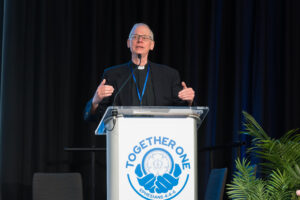
Photographed by Thomas M. Winger
Christ created the peace. He did so not by offering an idea but by being Peace in the flesh Himself and by undergoing the hard physical work on the cross. There He tore down the dividing wall, annulled the law by bearing its penalty, and incorporated us and all believers in Christ into His one body.
So, what does this mean? It means that peace and unity in the church are a gift from God rather than something we have created or have to create. It means that peace and unity come from being in Christ and remaining in Him. If we abide in Him, we will experience the peace and unity that He has wrought. If we separate ourselves from Him, we cannot expect peace to prevail….
We in the Christian church have a different vision of peace and unity than the world does. The world is content as long as people are not at each other’s throats. That is about as far as its concept of peace goes…. But that is not the peace that Christ brings. He has come to undo the curse of Eden, where we turned against God and against our fellow human beings. He has come to undo the curse of Babel, where our beautiful languages do not build up but separate us from one another.
He has not come to craft one more truce until our patience finally runs out and we take up weapons again. Instead, He has created a peace unlike any other. It is a peace founded not on an idea but on His being God in human flesh. It was a peace not won on the battlefield or in the negotiating room but on the cross and at the empty tomb. It is a rock-solid peace because it is founded on the most solid Rock of all, the Rock of our salvation, the God-Man, Jesus Christ.
This is the peace that we are called to enjoy, proclaim, and celebrate…. This is the peace that allows us to live as not just neighbours but as brothers and sisters, as fellow citizens in God’s kingdom, and as the very dwelling place of God.
Rev. Dr. James A. Kellerman is Associate Professor of Theology at Concordia Lutheran Theological Seminary (St. Catharines, Ontario). This article is a brief selection from the study of Ephesians 2:13-22 he presented at Lutheran Church–Canada’s 2026 Synodical Convention.
 LCC Facebook
 LCC Instagram