






Christ’s Death and Resurrection for Us
by Martin Luther
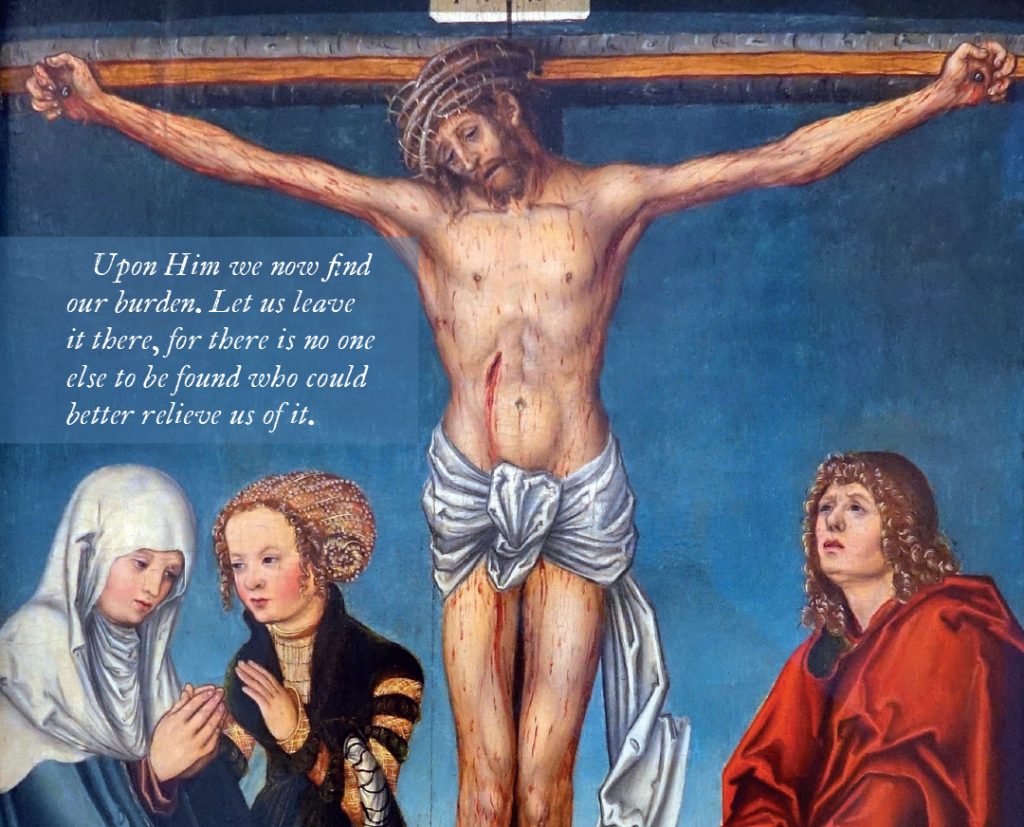
If we desire to understand the benefits of the resurrection of Christ, we must keep in view two distinct pictures. The one is sombre, full of distress, misery, and woes; it is the scene of blood presented to us on Good Friday—Christ crucified between murderers and dying with excruciating pain. This scene we must reflect upon with much earnestness to realize that it all happened on account of our sins: yes, that Christ as the true High Priest sacrificed Himself for us and paid our debts with His death. We all ought to know that our sins thus wounded and tormented Christ, and that His sufferings were caused alone by our iniquities. Therefore, as often as we remember or view this sorrowful, bloody scene, we ought to bear in mind that we have before us our sins and the terrible wrath of God against them—a wrath so dire that no creature could endure it, that all atonement became impossible except the one made by the sacrifice and death of the Son of God.
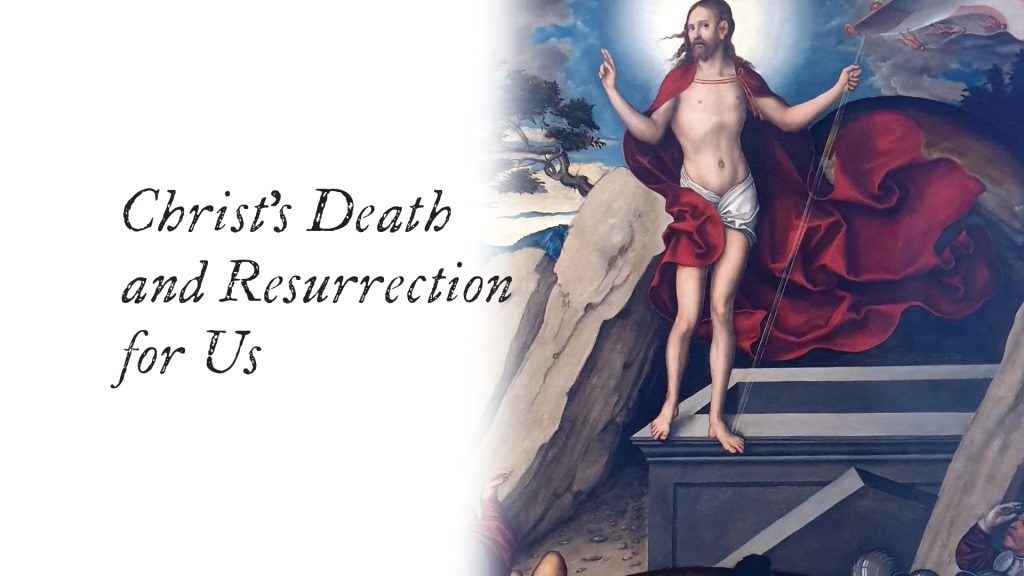
If this awful scene were the only one presented to our sight, and if it remained unchanged, it would be too terrible and painful. But this picture of sorrow is changed, and in our Creed we join closely together these two statements: Christ “was crucified, died, and was buried, and “He descended into hell;” but on “the third day He rose again from the dead.” Yes, before three days had gone by, our Lord and Saviour presents to us another picture, beautiful, full of life, lovely, and cheerful, in order that we might have the sure comfort that not only our sins were annihilated in the death of Christ, but that by His resurrection a new eternal righteousness and life was obtained, as St. Paul says: Christ “was delivered up for our trespasses and raised for our justification” (Romans 4:25). And in 1 Corinthians: “If Christ has not been raised, then our preaching is vain and your faith is vain… your faith is futile and you are still in your sins. Then those also who have fallen asleep in Christ have perished. If in Christ we have hope in this life only, we are of all people most to be pitied” (15:14, 17-19).
If we desire to be true Christians, it is necessary for us firmly to establish in our hearts through faith this belief: that Christ, who bore our sins upon the cross and died in payment for them, arose again from the dead for our justification. The more firmly we believe this, the more will our hearts rejoice and be comforted.
As in the former scene we saw the burden of our sin upon Him and bringing Him to the cross, so in this other scene of the resurrection we witness no longer sin, pain, and sorrow, but only righteousness, joy, and happiness. It is the victory of life over death—a life everlasting, with which this temporal existence on earth cannot be compared. About this we have reason to rejoice. Simply to view the former scene would be terrible; but when we view it in connection with the glad event of the resurrection, and when we bear in mind why our Lord suffered thus, we will gain from such contemplation much benefit and comfort. It will become clear to us how inexpressibly great the love of God toward us poor sinners was, as He had compassion on our misery, even to such an amazing extent that He did not spare His beloved and only Child, but gave Him up for us, to bear upon the cross and in death the burden of our transgressions, which were too heavy for us and would have crushed us to the earth. This load was taken from us and placed by God Himself upon His Son, who, as God from eternity, could alone bear the heavy weight of sin. Upon Him we now find our burden. Let us leave it there, for there is no one else to be found who could better relieve us of it.
The other scene presents to us Christ no longer in woe and misery, weighed down with the great mass of our sins, which God has laid upon Him, but beautiful, glorious, and rejoicing; for all the sins have disappeared from Him. From this we have a right to conclude: If our sins, on account of the sufferings of Christ, lie no longer upon us, but are taken from our shoulders by God Himself and placed upon His Son, and if on Easter, after the resurrection, they are no more to be seen, where then are they? Micah truly says that “all our sins” are cast “into the depths of the sea” (7:19); and no devil nor anybody else shall find them again.
If we desire to be true Christians, it is necessary for us firmly to establish in our hearts through faith this belief: that Christ, who bore our sins upon the cross and died in payment for them, arose again from the dead for our justification. The more firmly we believe this, the more will our hearts rejoice and be comforted. For it is impossible not to be glad when we see Christ alive, a pure and beautiful being, who was before, on account of our sins, wretched and pitiable in death and in the grave. We are now convinced that our transgressions are removed and forever put away.
 In the former scene of suffering and death we witnessed our sin, our sentence of condemnation and death resting heavily upon Christ, making Him a distressed, pitiable Man; now, on Easter, we have the other scene no longer mixed with sin. No curse, no frown, no death is visible; it is all life, mercy, happiness, and righteousness in Christ. This picture can and should cheer our hearts. We should regard it with no other feeling but that today God brings us also to life with Christ. We should firmly believe that as we see no sin nor death nor condemnation in Christ, so God will also, for Christ’s sake, count us free from these if we faithfully rely upon His Son and depend upon His resurrection. Such a blessing we derive from faith.
The day will come when faith shall be lost in sight. In the end, our bodies will also be perfected, so that neither sin nor death can have power over them. For the present we are as weak and sinful as other people; only we strive to shun open and flagrant sins. It is true, Christians may also, now and then, be guilty of these, but they remain not in them; they flee them again through earnest repentance, and obtain through faith forgiveness of all their sins. Therefore we must daily pray: “Forgive us our trespasses.” On the other hand, it may be that heathens and unbelievers, in their outward walk and life, appear before the world just as good, yes, even better than the true children of God. To know and judge a Christian correctly, it is necessary to make his faith the criterion. As to our flesh and blood we are sinners, must die, and suffer many evils upon earth—perhaps even more than others who have no faith, since Christians feel the burden of their sins and are troubled by them, while others can live in full security, undisturbed by their guilt. How then can Christians claim to be holy and free from sin? By believing that in Christ, who died for their sins and arose again from the dead, they have forgiveness, upon which they rely and which they earnestly seek in faith.
May we learn utterly to disregard our own holiness, and to keep before our eyes only this Easter scene: Christ arisen from the dead, the Conqueror over death, sin, and hell. If we thus look to Christ alone, and not to ourselves, it will be well for us. May our Lord Jesus Christ grant us this in mercy. Amen.
These two facts then belong together: through faith in Christ, we are pure and holy; on account of the old Adam within us, we are impure and sinners. This impurity we remember when we pray: “Our Father… forgive us our trespasses,” and are comforted in the faith that God, for Christ’s sake and in the power of His resurrection, hears us and forgives us, and grants us eternal life. Thus we are holy in Christ through faith, even if we are sinners; for it matters not how much is yet lacking in us: Christ our Lord and Head arose from the dead. He has conquered sin and death, and we, through faith in Him, are also freed from their power.
Let us therefore earnestly view and study this joyful, lovely, and blessed Easter scene. It is a picture without sin and death. If sin troubles us, if our conscience accuses us of evil deeds and faithlessness, let us remember and exclaim: “It is true, we are sinners, nor can we deny the weakness of our faith; but we comfort ourselves with the knowledge that Jesus Christ has taken our iniquities upon Himself and carried them. And by His resurrection, sin and punishment threaten us no more.”
May we learn utterly to disregard our own holiness, and to keep before our eyes only this Easter scene: Christ arisen from the dead, the Conqueror over death, sin, and hell. If we thus look to Christ alone, and not to ourselves, it will be well for us. May our Lord Jesus Christ grant us this in mercy. Amen.
—————
This article is condensed from Martin Luther’s “First Easter Sermon” in the House Postils. It is lightly adapted from E. Schmid’s translation in the 1884 edition by Matthias Loy.
 LCC Facebook
 LCC Instagram