





How Can I know I Am Saved? | Martin Luther on Justification
by John A. Maxfield
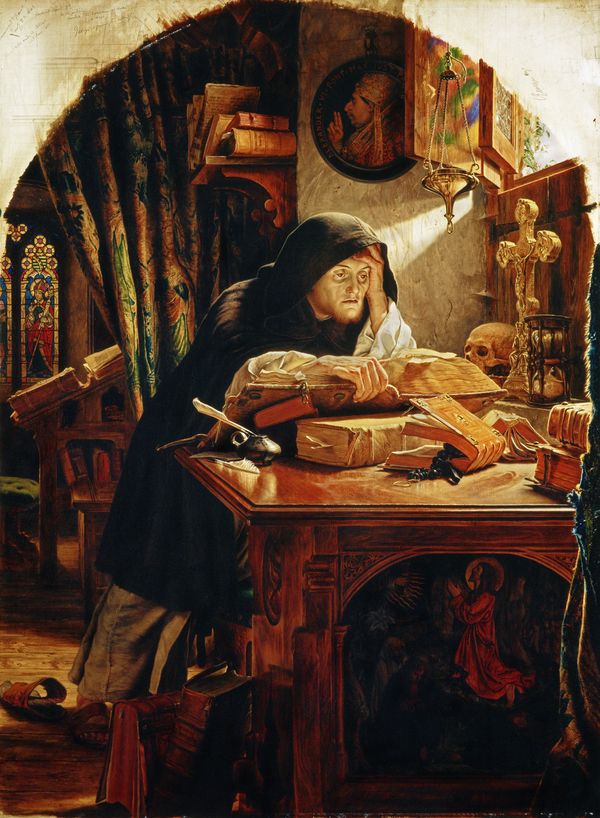
Painting: “Dawn: Luther at Erfurt,” Joseph Noel Paton (1851).
Most members of our congregations probably know that the Reformation started when Martin Luther published his Ninety-Five Theses on indulgences on October 31, 1517. The origins of Luther’s answer to the question, “How can I know that I am saved,” are more complicated than many Christians might realize if they’ve only heard the story through popular biographies of Luther and histories of the Reformation, or YouTube presentations. But it is much more important to grasp the outcomes of Luther’s spiritual journey than to understand fully the winding road that led Luther to his new understanding. For it was the outcomes and not the origins of Luther’s spiritual journey that have led to the different ways evangelical Christians believe and practice their faith today compared to Catholics.
Why do Protestant Christians emphasize the discipline of “going to church” on the Lord’s Day to hear God’s Word proclaimed by a preacher, while Catholics emphasize “going to Mass” (usually on a Sunday) whether or not there is preaching of the Word at such gatherings? Why is sermon preparation and Bible-teaching such important and time-consuming features of a Lutheran pastor’s regular work, while a Catholic priest focuses much more on performing the ritual of the Holy Mass (normally required daily for every Catholic priest)? Why do Protestants emphasize a daily or at least frequent personal “quiet time” or family devotions, where the Bible and other texts sharing God’s Word (such as Portals of Prayer) are read silently or aloud, while Catholics place greater emphasis on and require “going to confession” with their parish priest?
Over time, Martin discovered in Scripture the answer to his search for a gracious God and the biblical promise of certainty that he would be saved from death and hell.
All these and many more differences between Christians are outcomes of Luther’s spiritual journey and the Protestant Reformation. These differences (as similar and related though they might be) are the outcomes of the young Luther’s personal striving for certainty—through traditional Catholic piety—that he would be saved from death and eternal judgment. Martin’s spiritual journey, not just before but also continuing after he published the Ninety-Five Theses, was a personal experience of working through his very real terror of death and anxiety over God’s judgment. Over time, Martin discovered in Scripture the answer to his search for a gracious God and the biblical promise of certainty that he would be saved from death and hell.
Much later in life—just eleven months before he died—the old reformer described the spiritual anxiety he had experienced so many years before. As the old man Luther reflected on his early spiritual life, he wrote: “Though I lived as a monk without reproach, I felt that I was a sinner before God with an extremely disturbed conscience. I could not believe that He was placated by my satisfaction [the young Martin had been taught to perform satisfaction through the sacrament of penance or confession]. I did not love, yes, I hated the righteous God who punishes sinners.”
After describing the spiritual distress and misery he had experienced so many years before, Luther exclaimed: “At last, by the mercy of God, meditating day and night, I gave heed to the context of the words [of Romans 1:17], namely, ‘In it [that is, the Gospel] the righteousness of God is revealed, as it is written, “He who through faith is righteous shall live.” There I began to understand that the righteousness of God is that by which the righteous [person] lives by a gift of God, namely by faith.… Here I felt that I was altogether born again and had entered paradise itself through open gates” (LW 34:336-37).
The discovery that helped Luther resolve his spiritual anxiety over God’s judgment was captured in the phrase “justification by faith.” And so, justification by faith became the major teaching of the Protestant Reformation.
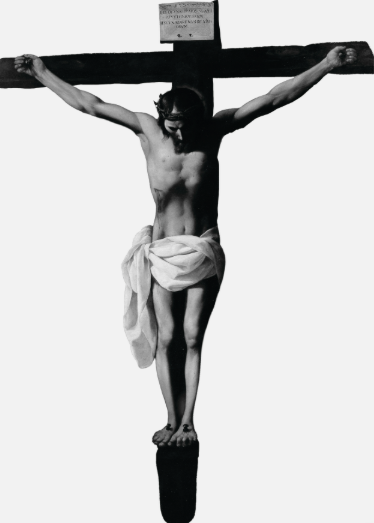
Painting: “The Crucifixion,” Francisco de Zurbarán (c. 17th century).
You might notice that the word “justification” does not appear in Luther’s words above. But the term “justification” is closely related to the word “righteousness,” both in the Greek of St. Paul and in the Latin Luther himself used in his words above. In Luther’s writings, and in those of other theologians of his time and later, both the teaching and the experience of salvation are described as receiving the righteousness of Christ as a gift through faith alone—that is, being justified by faith alone.
Notice the passive voice in those statements. Receiving. Being justified. Luther was certainly not the first theologian to talk about salvation in terms of “justification,” a technical term describing a judicial (court) process of declaring one innocent before the law. But Luther exposed misinterpretations of the Gospel in traditions of Catholic theology as well as confused understandings of how a person is justified (declared innocent) before God, both now and at the Last Judgment. At the heart of these incorrect understandings was the idea that a Christian is justified by God’s grace (God’s merciful attitude toward sinners for Jesus’ sake) working together with “good works.” According to Catholic theology then and now, a Christian is justified through “faith formed by love”—that is, by trusting God’s mercy and loving Him, as shown through good works prescribed by the Church.
Luther’s spiritual anxiety and terror before God’s judgement was grounded in the gnawing feeling his fervent efforts to love God and trust in His mercy were never enough. It wasn’t that God and the Church demanded perfection and Luther found himself to be a sinner; the Church has always considered itself to be a community of sinners living under God’s grace, teaching that such sinners are justified by grace. But in Catholic theology and practice, the grace of God is channeled solely through the mediation of the Church working through its ordained priesthood and the sacraments those priests administer. Luther did his best to find certainty of salvation through that grace of God operative through the Church. He even became a friar in one of the strictest orders of monasticism. Later, he was ordained a priest and offered the Mass and administered the sacrament of penance to others. But his life as a monk and priest did not solve Luther’s spiritual anxiety. When he offered his first Mass, he shook with terror before the holy God present at that altar, hidden under the consecrated bread and wine. Not even the “spiritual life” of the clergy offered him relief in his conscience.
Luther came to realize that God’s message to sinful humanity plagued by death was the promise of righteousness, and not the demand that we should make ourselves righteous.
What could and eventually did relieve Luther’s conscience was the promise of the Gospel that he found in the words of St. Paul, and then again repeatedly throughout the Old and New Testament. He came to realize that God’s message to sinful humanity plagued by death (Genesis 3) was the promise of righteousness, and not the demand that we should make ourselves righteous through our performance or participation in the sacraments of the Church. This understanding gave Luther relief from his anxieties and freedom from his burdened conscience.
The Reformation which Luther initiated came about through Luther’s own personal experience of freedom and his sharing it with others. Luther’s reform of the sacraments (reducing them from seven to two: Baptism and the Lord’s Supper) freed God’s people by changing the focus of their celebration from performance (administration of sacraments by the clergy) to reception by faith. All Christians are priests of God who receive God’s promise of forgiveness in the Word which He attaches to the visible element in the sacrament—the water in baptism; the body and blood of Christ “given for you for the forgiveness of sins” and joined to the bread and wine of His Supper.
By preaching freedom through the Gospel, the lives of Christians in Luther’s day were changed, and the way they practiced their faith also changed. Are you living in that freedom today?
Rev. Dr. John A. Maxfield is Professor of History and Religious Studies at Concordia University of Edmonton, and assistant pastor of All Saints Lutheran Church (Edmonton).
 LCC Facebook
 LCC Instagram