


Scripture and Prayer: The Art of Lectio Divina
by Richard A. Beinert
How is your Bible reading? How about your prayer life? These are important questions to wrestle through because, if we are honest, the vast majority of us have plenty of room to grow. And, if you’re anything like me, linking these two together—Scripture reading and prayer—becomes an extra challenge because, culturally, these two swim in different streams. Yet, when we look at the practice of the ancient Church, as well as Martin Luther and the Reformers who followed him, we see that reading and prayer fit together like hand and glove.
The ancient description of the prayerful reading of Scripture is captured by the Latin name lectio divina—that is, a “divine reading” of the biblical text through which we read, see, and learn but also are raised into prayerful conversation with our Triune God Himself throughout our daily lives.
Today, reading is often associated with fantasy, entertainment, or deep academic study. Many of us tend to put Scripture reading somewhere in this last category. I’m not suggesting that reading Scripture to deepen our understanding of the Bible is somehow wrong; but if we’re not careful, lectio divina can become side-tracked into a chiefly academic pursuit, rather than allowing the Holy Spirit to use His Word to wash deeply over, in, and through us—to draw us more deeply into that holy conversation of prayer where we become increasingly transformed by the Word of Christ. Reconnecting our lives of prayer to the Words of Scripture, then, should not be just a side-pursuit for us in our day and age, where prayer is too easily forgotten, but a return to our roots—our Christian roots—in Jesus Christ Himself.
We really don’t come to know Jesus without the Bible in our eyes, ears, and hearts.
St. Jerome, an important Bible scholar of the early Church, insisted that “ignorance of the Scriptures is ignorance of Christ.” We really don’t come to know Jesus without the Bible in our eyes, ears, and hearts. He goes on to elaborate that “reading invites application. Constant application produces familiarity. Familiarity produces faith and makes it grow.” For Jerome, it was important the Scripture not be used just ‘every now and then,’ but rather, as an as another ancient writer St. John Cassian encourages, regularly and intentionally. Cassian urges us to apply ourselves with all our strength to the reading of the Bible—to slow down and spend time in the Scriptures—until continual meditation fills our minds and draws us into its own likeness.
Both Jerome and Cassian remind us that God’s Word is busy and active, something Luther also echoed, the Word working like leaven in the lump of our lives, putting our Old Adam to death and raising us up renewed in Christ. Scripture fills us and transforms us as we linger over the words of the text. This is why Jerome described the hearing and reading of the Scriptures as an “opening [of] our sails to the Holy Spirit without knowing on what shores we will land.” As Isaiah once put it, God’s Word accomplishes that for which it is sent (55:11). For this reason, another giant of the early Church, St. John Chrysostom, admonished his hearers to mark the words of Scripture as they are read and preached in church, and then to bring them home, discuss them, and repeat them together. He even suggested that the home meal should include a healthy helping of Scripture as our spiritual food. All these ideas would be echoed 1,300 years later by Christian Scriver, a Lutheran pastor and devotional writer, as he sought to reawaken a lively concern for attentiveness to the sermon and the devotional use of the Scriptures in the aftermath of the Thirty Year’s War in Germany.
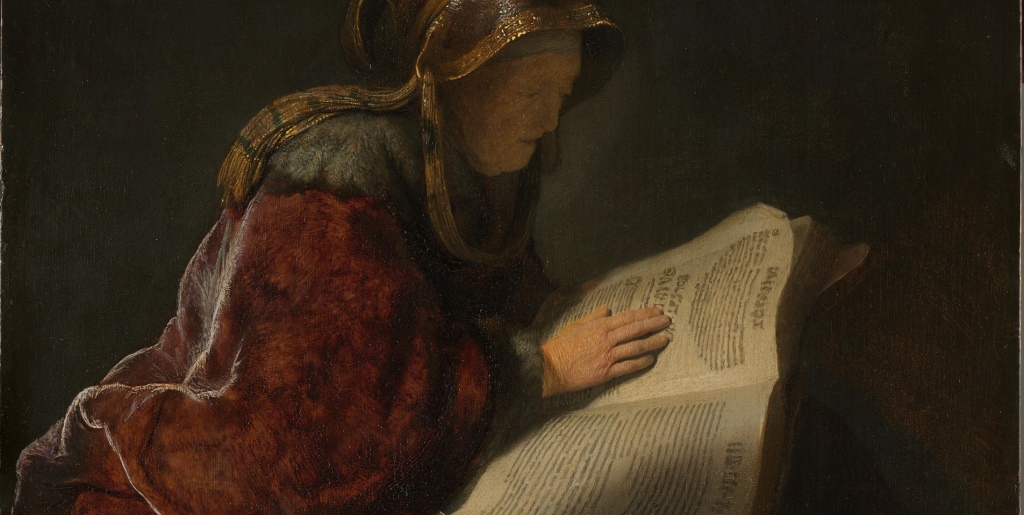
The Prophetess Anna: Rembrandt van Rijn, 1631.
You might be familiar with Luther’s own trio of prayer (oratio), meditation (meditatio), and trials (tentatio) as a model for the study of Scripture. Luther suggested that following this pattern of prayer helps to form us into great theologians like the sainted heroes of the ancient Church. Learning facts and details from Scripture is certainly part of this, but the process of meditation goes much deeper than speed-reading and memorization. Luther compares meditation to the slow process of a cow chewing its cud, where we take what we have read or heard and then “ruminate” on it—that is, intentionally turning it over in our memories, even repeating the words in order to hear them again and taste them in our mouths, so that we slow down and allow them to sink more deeply into the depths of our awareness.
This is where tentatio (trials) likewise come in. It is that feeling of struggle when the Holy Spirit, in and through the Word, works to reshape us, reform us, and renew us through His own activity. He leads us to become aware of our own particular knots of sin (we all have them), to unravel and break them, leading us always back to Jesus who feeds and nourishes us with His own life-blood at the Altar. That experience of having our Old-Adam-sinfulness challenged is always felt as a trial, as our old sinful self tries to keep its head above water. And yet, it is here, through the Word, that our Heavenly Father continues to pour out His Holy Spirit into our lives, in order to crush our sinful self and raise us to Gospel-newness of life in Christ. This is why prayer without Scripture as our anchor can so easily lead us astray; rather than building on Jesus whom we meet in the Word, we build upon our own inner impulses and ‘whatever seems best’ in our own eyes.
Prayer without Scripture as our anchor can so easily lead us astray.
How do we do all this in daily life? Going to church and being actively attentive throughout the worship service is the best place to start. This is the original practice of lectio divina which arises out of the Scriptures. It forces us to get ‘out of our own space’—not just physically, but emotionally and intellectually. We we set aside our own head-space in order that Christ might fill us. Another thing we can do is to slow down deliberately when we are reading and praying. Too often, we look at devotional times as ‘just another thing I gotta do,’ and we don’t actually allow time or space for our Heavenly Father to speak His peace into our hearts. Luther, in writing to his barber, once suggested that we rush too much in our prayers; it is better, he said, to slow down and tarry—to linger—over words, phrases, expressions that catch our interest, surprise us, or challenge our way of thinking. These are teachable moments that the Holy Spirit gives us, in order to knock us out of our sinful-self ruts so that we can be renewed by Christ.
Luther and later writers also used lectio divina as a way to encourage people to see their own lives through the lens of God’s Word. One example is learning to think of reading Scripture as if you were putting on your trousers. You have four pockets to fill with what you need for the day: two for the Law and two for the Gospel. One to curb your sin (Law) and one to treasure words of grace and forgiveness for your sins (Gospel). One pocket to remind you of your obligations towards your neighbours (Law) and the other to remind you to live in love and grace (Gospel).
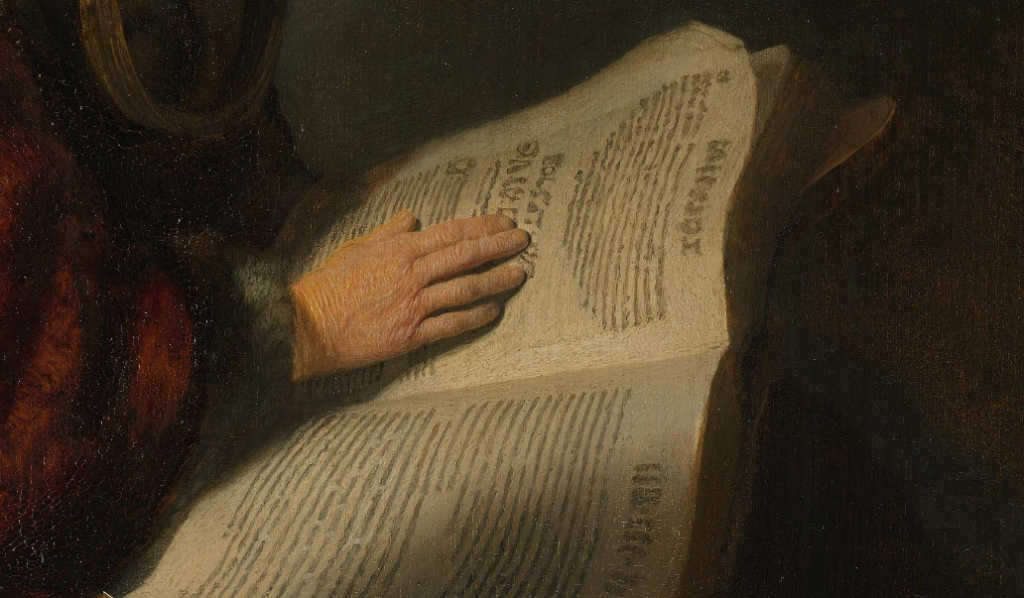
Christian Scriver also liked the image of a family chest where money is stored. He reminded his readers that in the same way we store up coins for our future—for our children’s future—we should likewise make a point to encourage our children to store up (i.e., to memorize) Scripture as our treasure for eternal life. Scriver even recommended the practice of searching the Bible for verses that start with each letter of our names, so that we begin to see God’s Word inscribed even within our own identity in the world.
Another excellent example comes in the hymn “Speak, O Lord, Your Servant Listens” (LSB 589), written by Anna Sophia von Hessen-Darmstadt, abbess of a Lutheran sister-house in Quedlinberg in 17th-century Germany. Here she puts into words the inner-motion of lectio divina in a musical form. Her hymn is a beautiful reflection on the sweetness of the Scriptures, depicting a deep desire to be fed, formed, and filled by Jesus. Anna Sophia connects the life of Scripture and prayer in one beautiful motion that carries us throughout our lives. Her hymn is likewise a reminder that the hymnody and liturgy of the church is itself a way for us to chew on God’s Word as a model of meditative prayer!
Retraining our hearts and minds to this kind of attentiveness is perhaps the tentatio of our time. May the Holy Spirit help us to rise up to meet this challenge in faith!
—————
Rev. Dr. Richard A. Beinert is pastor of Saint James Lutheran Church in Winnipeg.
 LCC Facebook
 LCC Instagram