


Without Ceasing
by Mathew Block
“Pray without ceasing” (1 Thessalonians 5:17).
 This command—part of St. Paul’s parting words in his first epistle to the church in Thessalonica—is one that I confess I do not always keep very well. You don’t need me to tell you just how easy it is to become distracted by the demands of daily life. No matter what you accomplish today, there’s always something else waiting for you by the time tomorrow rolls around. There’s always another task to get done at work, always another chore to get done around the home, always something else demanding your time and attention.
None of these things are wrong on their own; many are good, even necessary. And yet, they are not the ultimate good. Remember Jesus’ visit to the home of Mary and Martha. Mary “sat at the Lord’s feet and listened to His teaching,” we read, but “Martha was distracted by much serving (Luke 10:39,40). Annoyed with her sister, Martha asked Jesus to tell Mary to help her. But Jesus refused: “Mary has chosen the good portion,” He said, “which will not be taken away from her” (v. 42).
Work is good; but as Christians we are called to prize time with Jesus and His Word as our greatest good. This is why, in the Third Commandment, God charges us to “remember the Sabbath day, to keep it holy” (Exodus 20:8). “Six days you shall labour, and do all your work,” He commands, “but the seventh day is a Sabbath to the Lord your God” (v. 9). God knows that time with Him is even more important than the work which earns us our daily bread. For “man shall not live by bread alone,” after all, “but by every Word that comes from the mouth of God” (Matthew 4:4).
It is not physically healthy to work without rest. Nor is it spiritually healthy to live without God’s Word. “We should fear and love God so that we do not despise preaching and His Word,” Martin Luther writes in the Small Catechism, “but hold it sacred and gladly hear and learn it.”
This is especially true of our participation in the Divine Service at church on Sundays. For it is in church that we hear proclaimed the Gospel of Christ crucified and raised again for our salvation. It is in church that we receive absolution for our sins. It is in church that we receive His body and blood for the strengthening of our faith. But the command to hold God’s Word sacred isn’t something just restricted to Sundays. We hold it sacred by meditating upon it during the rest of the week too—by reading it in private or family devotions, by singing hymns infused with the teaching of Scripture, by responding to God in prayer.
“Pray without ceasing,” St. Paul urges. The more time we spend with God’s Word, the more we come to inhabit that posture of prayer which the Apostle encourages. For the Holy Spirit is active through the Word of God to bring about our sanctification. Like the Thessalonians, then, we are called to receive Scripture wholeheartedly “not as the word of men but as what it really is, the Word of God, which is at work in you believers” (1 Thessalonians 2:13).
God is at work in you through His Word. And though—like me—you may fail to “pray without ceasing,” God’s Word is nevertheless still at work in you, drawing you ever deeper into the life of Christ. For ultimately, we do not spend time in Scripture just to become more “spiritual,” as if that were an end in and of itself. Instead, we go to Scripture to meet Jesus and know Him better. For it is Christ—not your own spiritual accomplishments—who saves. It is Christ, killed on a cross and risen again from the dead, who forgives your sins—including your spiritual inadequacies—and assures you of salvation.
But the miracle is that, as we look to know Christ better through the Scriptures, we are increasingly made to be like Him. We look to Jesus, “beholding the glory of the Lord,” only to find we “are being transformed into the same image from one degree of glory to another. For this comes from the Lord who is the Spirit” (1 Corinthians 3:18). We become more spiritual people not as a reward for our hard work in studying the Bible then but rather as a gift from God as we look upon Jesus, the “founder and perfector of our faith” (Hebrews 12:2).
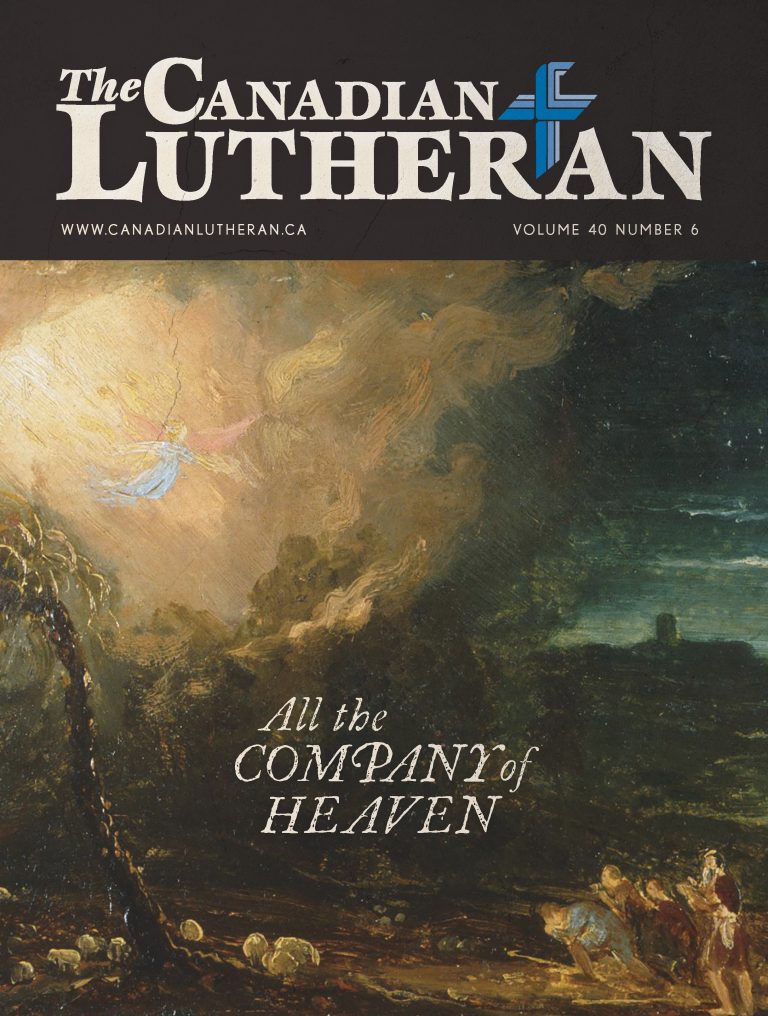
In this issue, we discuss devotional practice in the life of the Christian. Dcn. Samantha Neeb discusses the benefits of a home devotional life (page six). We read a reflection on discipleship from a new devotional by Rev. Mark L. Smith (page nine), and another on resting in the Lord from the classic devotional writer Johann Gerhard (page eleven). Rev. David Haberstock, meanwhile, reminds us of the importance of regular Bible reading (page 24).
Heavenly Father, teach us to embrace Your Word and study it more faithfully—not merely with the goal of being “better” Christians but rather to know Your Son and His mercy more fully. And as we look to Jesus, O God, work in our hearts through Your Holy Spirit, that He might form us ever more into the image of Your dear Son. Amen.
Mathew Block is editor of The Canadian Lutheran magazine and communications manager for the International Lutheran Council.
 LCC Facebook
 LCC Instagram