




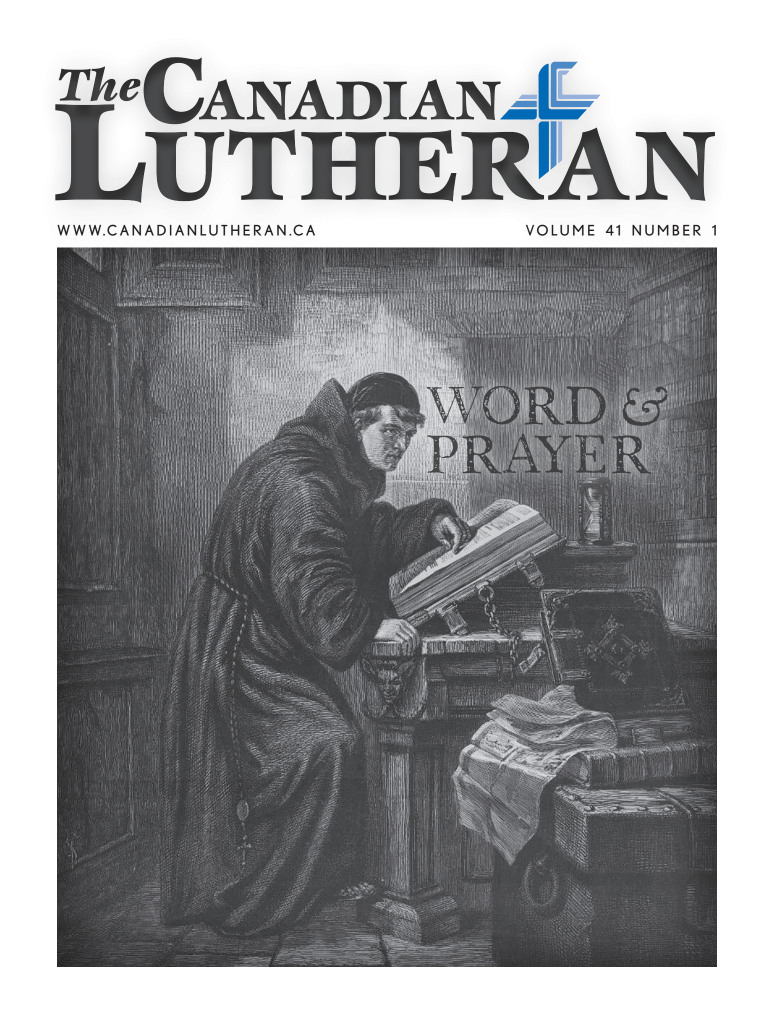
Word and Prayer
 by Mathew Block
The Christian’s home devotional life revolves around Scripture and prayer. Like congregational worship—where we gather to receive God’s gifts in Word and Sacrament, and then respond to Him with prayer and praise—so too in our personal lives we should take time to meditate upon His Word and offer up our own prayers to Him in response.
Pursuing just one of these devotional practices—Bible reading or prayer—while neglecting the other leads us into dangerous territory. The Bible is not to be approached without a prayerful attitude, as if it were just a book of facts that we can master with enough study. No, God’s Word is “living and active,” and must instead master us (Hebrews 4:12). Mere knowledge of doctrine is not enough. After all, even the demons have that (James 2:19)!
At the same time, a prayer life which is not shaped by the Bible can quickly go off the rails. Jesus Himself rebukes the Samaritans—who did not accept the full Scriptures—for their worship of “what you do not know” (John 4:22). A faithful prayer life must be grounded in both Spirit and in truth (John 4:23-24)—namely, the truth of God’s revealed Word. It is Scripture, after all, that reveals the good news of the Gospel to us.
As we meditate on Scripture, the Holy Spirit forms in us the mind of Christ. For Christ is Himself the Word of God. And as His mind is formed in us, we learn to desire the things that He desires—to will what He wills. Our prayer life is thereby also transformed. We learn to pray as He would have us pray. Word and prayer are intrinsically connected.
The relationship between Word and prayer is especially clear in the Psalms, for they are both Scripture and prayer at the same time. The Psalms model for us the appropriate response to God’s Word, and we seek to make the psalmists’ words our own: “I will meditate on Your precepts and fix my eyes on Your ways,” we say. “I will delight in Your statutes; I will not forget Your Word” (Psalm 119:15-16). The psalms also model for us the importance of prayer, and we seek to make these words our own as well: “Give ear to my words, O Lord; consider my groaning. Give attention to the sound of my cry, my King and my God, for to You do I pray” (Psalm 5:1-2).
Word and prayer are intrinsically connected.
These are words written by others; and yet, as we learn to pray them, they become our words also. Our prayers. And yet, as Scripture, they are also God’s Words. As we pray the Psalms then, we pray with other believers and with Christ Himself, His Word mingling with our own words.
 This is the kind of prayer to which we aspire as Christians. For when we pray in this way—in words which are steeped in God’s Word and with a will that seeks what God Himself wills—we are promised that we shall indeed receive that for which we pray. “Ask, and it will be given to you,” Jesus promises. “For everyone who asks receives” (Matthew 7:7,8).
As sinners, of course, we do not always or even often pray in this kind of way. We do not perfectly understand God’s Word, and so we often fail to pray in accordance with it. We ask for what we think is best, but it is not always the good which God Himself desires. Our motivations are frequently mixed and impure—and so we do not receive (James 4:3). We need mercy, therefore, in our prayer life as much as we need it in everything else.
We do well, then, to pray as our Saviour Jesus Himself prayed, saying to God: “Nevertheless, not my will, but Yours, be done” (Luke 22:42). When we pray in this way, we recognize that however God answers our prayers will be good—even if we do not always recognize His answer as good this side of heaven. We know we are imperfect. And so we rely on the Holy Spirit to pray in our stead when we do not know what or even how we ought to pray (Romans 8:26-27).
Our features this issue explore the devotional life, focusing especially on the relationship between Word and prayer. Rev. Dr. Richard Beinert explores the ancient Christian practice of lectio divina—that is, learning to read Scripture in a prayerful, contemplative way. Rev. Cameron Schnarr, meanwhile, focuses on Martin Luther’s emphasis on prayer, meditation, and testing. Finally, President Timothy Teuscher reflects on what it means to live a life of repentance—not only in Lent but throughout the entire Christian life.
Devotional practices, we know, do not save us. But they are not for that reason unimportant; they direct our attention ever back to the One who has saved us: Jesus Christ, God’s Son, our Lord. Through His death, He has rescued us from sin and death. And through His resurrection, He gives us new life and a new will that seeks to follow where He leads. We willingly hear His Word, therefore, and respond to Him in prayer.
Heavenly Father, awaken in us a love for Your Word and for prayer. For Your Son has promised us: “If you abide in Me, and My Words abide in you, ask whatever you wish, and it will be done for you” (John 15:7). Help us to abide in Christ and His Word in us, dear Lord, that we might learn to will and to pray as we ought. We ask this in Jesus’ name. Amen.
—————
Mathew Block is editor of The Canadian Lutheran and the Communications Manager of the International Lutheran Council.
 LCC Facebook
 LCC Instagram