




Bound to Sin? Luther’s Bondage of the Will
 by James Kellerman
If people know of one writing by Martin Luther, it is his 95 Theses. Surprisingly, though, Luther never named it one of his best writings. Instead, that honour belongs to The Bondage of the Will, which is celebrating its 500th anniversary this December.
It was written in response to the Diatribe of Desiderius Erasmus, a brilliant philologist and Renaissance humanist who sought to reform the Roman Catholic Church while staying within its fold. In the Diatribe, he faulted Luther for making bold assertions on difficult topics such as the freedom of the will. Erasmus argued that Christians should leave doctrinal matters to the bishops or the consensus of the church fathers and instead just focus on improving morality. His advice dovetailed with his own belief that Christianity was largely about inculcating good behaviour and that everybody had the power to make the right choice.
Erasmus did not realise that he had stumbled into a major controversy with Luther. Erasmus had picked a quarrel over what he saw as a minor issue to prove his loyalty to Rome so that Rome would leave him alone. But Luther thought that Erasmus had gone for his jugular. If humans have the innate ability to choose God and adopt good behaviour, then there is no need for Christ to save us or for the Holy Spirit to bring us to faith. God would justify us based on our works rather than on His grace.
The Bondage of the Will is the usual English title of the book, but Bound Choice would be a more accurate translation. The question was not whether the human will might be tainted by less than noble desires, but whether human beings before their conversion retained the power to choose God freely and make good moral choices despite those human weaknesses. Erasmus said yes, and Luther said no.
The question was not whether the human will might be tainted by less than noble desires, but whether human beings before their conversion retained the power to choose God freely and make good moral choices despite those human weaknesses. Erasmus said yes, and Luther said no.
Their answers had implications for the rest of their theology. Because Erasmus thought that Christianity was about fostering morality, he thought the average Christian did not need to delve deeply into theology but could rely on the church’s wisdom. Even theologians should avoid clear assertions because the Bible was often obscure, and expounding its theological topics did not help anyone.
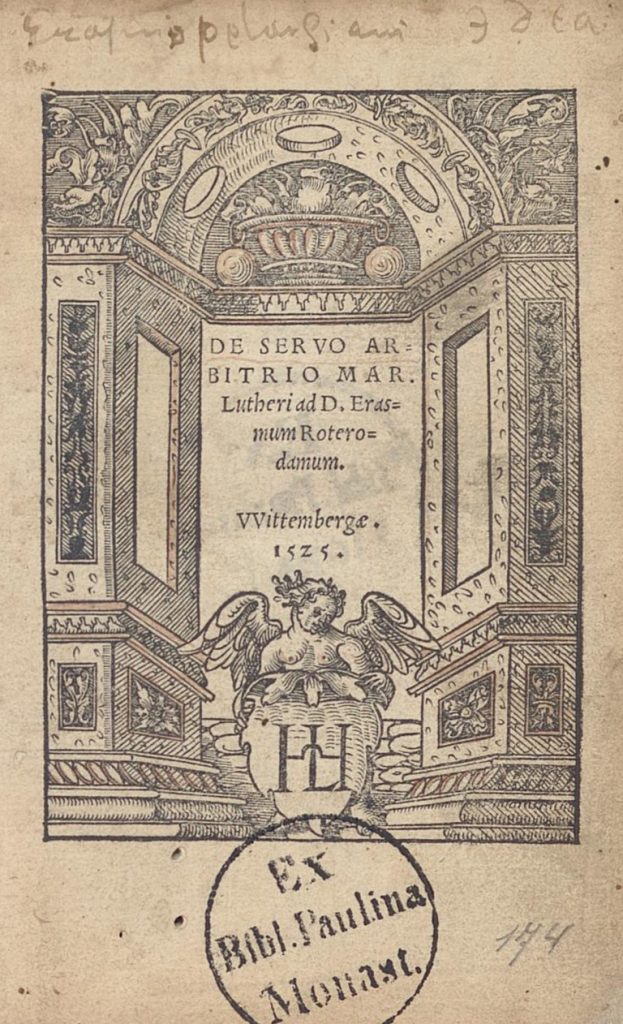
Title page of De Servo Arbitrio (Martin Luther, 1525/1526). Digital image: Wikimedia Commons. Public domain.
In contrast, Luther insisted that Christians live by making assertions—assertions based on the Scriptures. The Scriptures themselves are clear, for God has given them to us so that we may know Him. If they are obscure or if people misuse their content, it is because the unconverted human heart naturally rejects their clear truth. Everything in the Bible, including difficult topics such as predestination and bound choice, is to be taught, for the Scriptures are God’s gift to us.
Erasmus put the burden of salvation upon our ability to choose God freely. Thus, he minimised God’s gift of revelation as obscure and pointless except insofar as it might lead to our moral improvement. But Luther correctly understood that fallen humanity in its unconverted state cannot choose God or bring itself to believe in Him. Instead, God has to take the initiative at every step. He has to impart His revelation, and He has to change our will from loving sin to loving Him. Once He does so, our will delights in God and His gifts, and we show our appreciation for His gifts by clinging to the faith He has given us and by asserting whatever the Scriptures teach. By doing so, we proclaim that we are saved by God’s grace alone. And we begin to abound in good works, now that He has renewed our mind.
But if fallen humanity in its natural state is bound to choose evil, aren’t we saying that human beings are like rocks that have no choice in what happens to them? Aren’t we actually discouraging people from doing the good they otherwise could have done? And isn’t this doubly true if we insist, as Luther did, that God directs all things and that nothing happens apart from His will? Doesn’t this make God the author of evil? These were objections Erasmus had raised.
Luther replied that fallen human beings do not sin against their will. Their choice is bound in the sense that unconverted human beings cannot authentically choose to do good works out of love for God as Christians can do in some measure. As Luther explained elsewhere, unbelievers may do some astounding works, but these works do not please God, for they are not done out of faith in God and love for Him. Inevitably, unbelievers sin, whether they do blatantly evil deeds or do outwardly good works but then adopt a self-righteousness that trusts in their own goodness. Either way, people sin willingly. For example, Judas was not forced against his will to betray Jesus, but he freely chose to do so. Consequently, Christ could predict that Judas would betray Him and yet still fault Judas for making that wrong choice.
Luther compared God to a horseman riding a lame horse or a carpenter using a defective axe. No matter how skilled the horseman is, the horse will have a crooked gait. No matter how skilled the carpenter, the axe will mar the wood. Fallen human beings similarly distort the good action of God. We live, move, and have our being in Him (Acts 17:28), and thus every movement of ours must flow from His providence—but we alone are responsible for the defects caused by our sins.
If humans have the innate ability to choose God and adopt good behaviour, then there is no need for Christ to save us or for the Holy Spirit to bring us to faith.
As Luther understood but Erasmus did not, we are not born morally neutral. Therefore, God is not starting from scratch when He deals with us. We begin as fallen human beings, and we will continue to be such unless He does something about it. Thus, He is not responsible for making us evil—that is the fault of the devil and our ancestor, Adam. Instead, God finds us as the devil and our fallen human nature has rendered us: sinners whose will is not open to Him.
Why then, Erasmus asked, does God command us to do good and avoid evil if we are bound to sin? Why does He offer to reward good behaviour and punish evil? Luther replied that these impossible commands teach us how powerless we are without God. It is the only way He could get through to our stubborn hearts. Moreover, God rightly rewards good and punishes evil because we are never compelled to sin against our will. Our will before conversion may always choose to sin, but it does so willingly, and so our punishment is just.
All of this may be true, you may say, but does it have any practical application for us? Yes, for the Scriptures never make idle points. First, this doctrine shows us where we stand. How can fallen human beings vow to do good works without first sizing up whether they have the ability to do so? More than that, it leads us to despair of ourselves, which opens us up to faith in Christ as our Saviour. As Luther noted, this doctrine at first led him to despair, but the more he despaired, the nearer he was to grace.
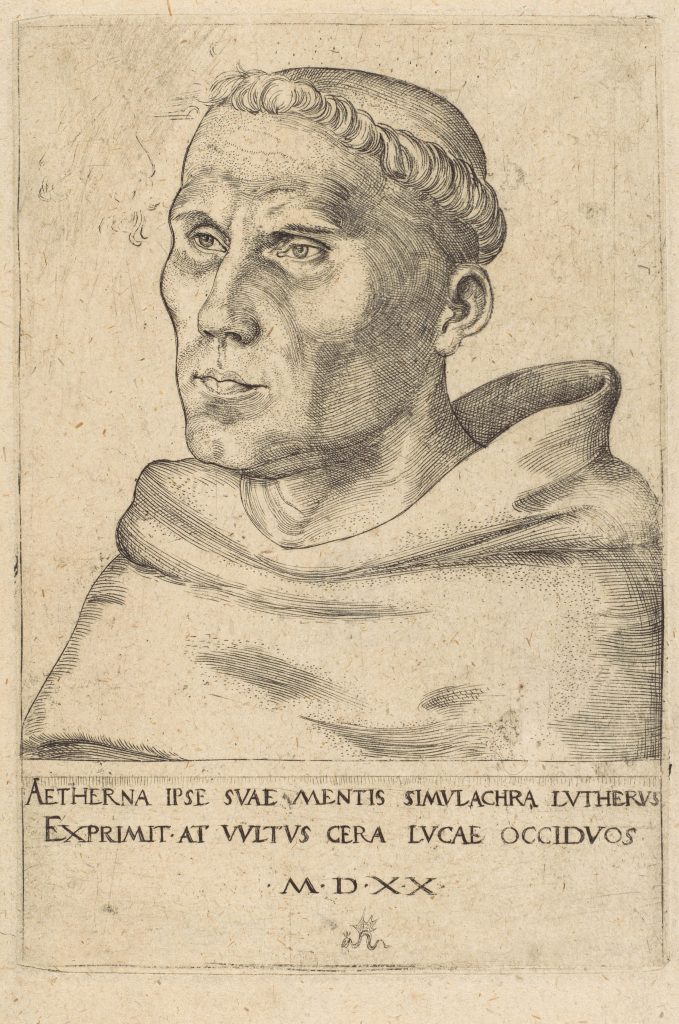
Martin Luther as an Augustinian Monk, Lucas Cranach the Elder (German, 1472-1553), 1520. Engraving. Digital image: The Metropolitan Museum of Art, Open Access. Accession no. 20.64.21. Public domain.
Furthermore, this doctrine points us away from ourselves to God and His absolute governance. It lets God be God. And that is a good thing because the Scriptures reveal that God is just and merciful. Even if at times He appears to be unjust, letting the wicked flourish and the righteous suffer, the God of the Scriptures reveals the truth—a truth that we will see more clearly with our eyes on the Last Day. Until then, we trust that God does not lie and will not disappoint. We stop relying on our own fickle choices, and we rejoice that God has chosen to redeem us through the life and work of His Son, our Lord Jesus Christ.
It is no wonder, then, that Luther called this treatise one of his best writings. But as any author knows, no work is beyond tweaking. One problem Luther recognised was his argument from “necessity.” He had argued that human beings cannot control their own will because God controls everything that happens in the world. Everything happens by necessity, as determined by God. Later, in his lectures on Genesis, Luther backed away from such language to avoid the impression that he was teaching that humans were coerced by God to sin. But his overall point remained: fallen human beings before their conversion can only choose sin, which they do willingly. Christians do genuinely good works (mixed in with their sins), but the fact that we can do so is because God has changed our will so that we can delight in Him and in His will.
Despite the passage of time, Erasmus’s idea remains popular, among Catholics and Protestants alike: human beings have free choice to obtain their own salvation through their good works. Thus, we would do well to read Luther’s Bondage of the Will and learn from him that God freely chose us because we could not choose Him.
—————
Rev. Dr. James Kellerman is Associate Professor of Theology at Concordia Lutheran Theological Seminary (St. Catharines, Ontario).
 LCC Facebook
 LCC Instagram